Showing posts sorted by date for query louise bourgeois. Sort by relevance Show all posts

Saturday, February 14, 2026

Feminine Writing: The House With the Golden Windows

the house with the golden windows


In 1993 I made a paper and canvas piece entitled The House With the Golden Windows.  It was inspired by a childhood memory from when our family drove home from Fort Frances.  My mother would half turn her head from the front seat and point at the small farm houses set back from the road, their windows glinting from the late afternoon sun. “Look at the golden windows” she said.

Last week I found an envelope of black and white photos of the house. I'd like to talk about them in today's blog post.   

Helene Cixous

This art piece is an example of Feminine Writing, described by the important French philosopher / intellectual / writer, Helene Cixous. (born 1937)   She said

The feminine writer, like a mother, looks with a look that recognizes, studies, respects, doesn’t take, doesn’t claw, but attentively, with gentle relentlessness, contemplates and caresses, bathes, and makes the other shine.  She brings back to light the life that has been buried.  She signs its name.  


I believe that this sewn house is feminine writing because it shines a light on the domestic day to day.  It makes that daily life shine while using feminine techniques and materials.  

For one year, I took a photo every day from within the house I lived in with my family in Kenora, Ontario.  Every day I chose an interesting or beautiful sight from one of the windows, and then snapped it with my film camera.  Although the east side of the house did not have many windows I did take a few from the window over the kitchen sink that looked directly at where the neighbour kept his garbage cans.  

However, my favourite view was of the back yard.  It could be seen from the many north windows and most of the 365 photos are from the north side of the house.  

the north wall interior

I was a mother artist when I made this piece.  You can see the children's sandbox from the north facing windows.  The house was finished in time to exhibit it in the Lakehead University degree show in the spring of 1993.  We moved to Manitoulin that same year.    


this detail of the north window shows the maple tree and the neighbour's fence


I didn’t realize that was to be our last year in the house when I began taking those photos. 


the house with the golden windows, 1993


The house is an installation.  I wanted to make a piece of art that would require my viewer to move around it in order to understand it.  I wanted that same viewer to enter into the house and feel some kind of emotion.  I wanted my viewer to experience my work with the body.


Ann Hamilton

Ann Hamilton, (born 1956), was working with the idea of the body as a way of knowing during that time.  There was an article about her installations in an early 90's  Fiber Art magazine when I was just coming up with the idea to make this house.  Although I wasn't yet familiar with Helene Cixous, I knew about Ann Hamilton.    


When we experience something with the senses (smell, touch, hearing, sight)  and also with movement, we become open.  We receive and resonate.  We experience a poetic recognition.   


Louise Bourgeois

Another artist that has influenced me when I was making the House with the Golden Windows is Louise Bourgeois. (1911 - 2010)   Her art helped her deal with her emotions.  She needed to make art. 

She also expected her viewer to have an emotional response to her work.  She famously said, "If you are not touched by my work, then I have failed."  
Femme Maison  1946
 by Louise Bourgeois

Louise Bourgeois was 35 years old and was raising three boys when she made this piece.  She believed that the domestic world of a mother artist was worth making art about.    

“Art is not about art. Art is about life, and that sums it up."  she said. 

But what emotion do you think Louise Bourgeois is communicating with her image of a woman squeezed into a building?  She made other Femme Maison pieces. See here. 


This house is about domesticity, yet it is not a domestic object.

This piece was made for an art gallery.  The reason that I don't have good photos of it is that it needs an art gallery kind of space to install it in.  

I believe that quilts are art.  I have always believed that.  By making an installation like this, obviously for exhibition, I help others to realize that sewing and patchwork are valid techniques for art making.  


I turned 40 in 1991, and was just beginning to take ownership of the idea that I could be an artist and a mother at the same time.  I leaned into art as a kind of salvation.  I didn’t keep my art passion a secret from the family, but I also didn’t talk about it.  I did it.  I also did my best to be a good mother.  I don't know how I did it now that I look back.  People ask.

I do know that my art was and is a place for me to be truly me.    

Tuesday, February 06, 2024

The books of Louise Bourgeois


At the age of 91 years, Louise Bourgeois created Ode a L'Oubli, (Ode to Forgetting),  a book of 35 fabric pages made from her own saved clothing.    (2002)  

In the catalog for the 2022 exhibition, Louise Bourgeois: The Woven Child, Bourgeois' books are shown as grids so that we can see all the pages at one time.  Each of Louise’s pages is about 11 x 12 inches.  If you want to see how this book looks when it is closed, or opened page by page, go to this link:  MOMA.  

In 2004, she made another book, The Woven Child

All of the pages in The Woven Child were woven from strips of fabric.

Within the grid of straight weave, she depicted her favourite motifs.  The hand, the house, the female body, the pregnant body, the human head.


She used her own clothing to make the pages, saved for decades.


Ode a la Bievre was made in 2007, when the artist was 96 years old.  It is about the river that she grew up on in France.


She made The Fragile in 2007 as well.  Not a book but a suite of drawings/paintings relating to mother/child ideas of the artist.  She said that her mother was like a spider, always able to repair the web, a strong and yet vulnerable being.  One of Bourgeois most famous works is her set of several steel spiders, made in many versions and stand as large outdoor sculptures outside of the world's great art museums.  See the Guggenheim spider at this link.


Eugenie Grandet 2009

A suite of embroidered illustrations that interpret the main female character in the novel by Honore Balzac, which was about a young woman named Eugenie who was not able to be romantically fulfilled because of her tyrannical father.  Read more about it and about why Louise Bourgeois wanted to make this suite of embroideries in this Guardian article from 2011.  

Louise Bourgeois died in 2010, at the age of 99.   That she carried on creating original work until the end is very inspiring for all of us.  The work she made in her 80's and 90's is uplifting, personal, and made from memory cloth.  It is inspiring for anyone who works with stitch.  I have studied her work for years, and have written about her many times on this blog (10 times!  click here) and also twice on the Modernist Aesthetic blog.   

The newest post on modernist aesthetic is Louise Bourgeois: The Woven Child

Tuesday, April 12, 2022

I keep journals

Sometimes, we think that things we say or think are important.   
They are.  

It's worth it to think and feel and remember.
Not worth a lot of money, but worth a lot of SELF.
A notebook / scrap book / is a way to keep a conversation going with the inner inner.
It's a way to keep the self open and trusting and aware.
I spend time every day on my journal.
It's not a waste of time. 
I am worth it.  
I continue learning.  
I study and take notes
 
The above sketch is of one of Louise Bourgeois' sewn head sculptures.
When I come across old family photos I save them.   

I also save things I find in old journals like this poem by Louise Rogers.


At the front of every journal, I list the books I am reading and give a wee review.

I tape the year on the spine 

Every morning I start a new chapter with the day's date.  
You can't think "my life is more important than the work"   
You have to think that the work is paramount.
Adventurous
One new thing after another
say "what do I like?"
      "what do I want?"
Find out exactly what you want in life.
To progress in life you must give up the things that you do not like.
When you go along with others you are not really living your life.
Find your way.
Happiness is being on the beam with life.
Agnes Martin  said this and I copied it and found it and taped it.
There is a two minute video of me speaking about this on my vimeo account, click here. 

Thursday, October 28, 2021

loss / beauty /our exhibition


There's a beautiful exhibition going on right now, miles away from me.  It's called In the Middle of the World and I'm really proud of the work in it and how it is installed.  

It feels a bit strange though, to have my work up on display there, and yet continue on with ordinary life here on Manitoulin.  


"There is such a shock after a show.  A show is an experience and after a show the artist is a different person.  He/she moves on.  So does the work."  

Louise Bourgeois said that in 1976.  It's how I'm feeling.


The exhibition is a two-person one with my colleague and good friend, Penny  Berens, who lives in Nova Scotia.  Penny and I discussed our work and how and where it would be shown with Miranda Bouchard, a free-lance curator who lives, as I do, in northern Ontario.  We both leaned on Miranda for layers of support.  


I wrote about Penny Berens's beautiful wall pieces on my Modernist Aesthetic blog.  Go see


I wrote about my sculptural textiles on Judy's Updates.  Go see that too, please.   I included my poetic artist statement in with the images, so that it would seem as if you are listening to someone read it into your head as you move through the exhibition.


let it all go 
the small middling tall bigger really the biggest and all things
let them go dear.
so comes love.

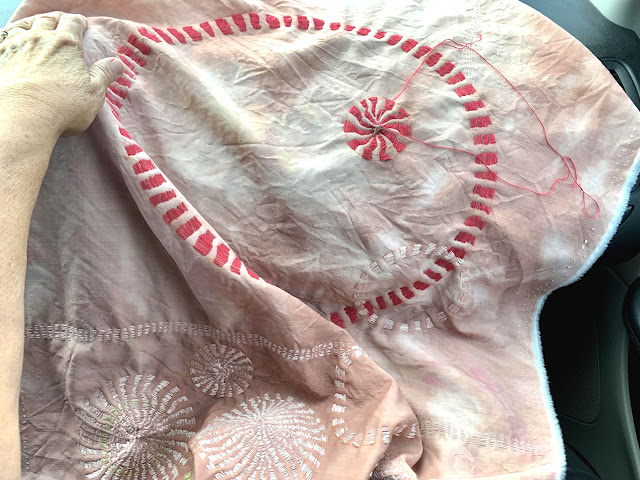
All the images are from Manitoulin Island, taken from car windows during a drive with my husband last Sunday.  The stitching I had in my lap is a new piece, I don't know what it is about.  

Friday, April 16, 2021

like breakfast, lunch and dinner

Q  Where do you find inspiration?

A   I am inspired by two things.  The first is the ever-changing natural environment I live within.  All seasons are beautiful.  The air is beautiful, affected by the time of day and the light, the growth and decay of the vegetation are beautiful, the way that colours look next to each other because of the way the angle of sunlight touches them, that's beautiful.

The empty spaces, and the birds on the tops of trees, also beautiful.

These things feed me like breakfast, lunch and dinner.  I don't consciously try to reproduce them in my work, but they show up in an abstract way.  They have become part of me.  Enhanced by my chosen solitude while walking, driving, sitting in my chair, observing and breathing in nature, is all so beautiful.

The second thing is looking at art.

I especially like looking at large-scale textile sculptures and minimalist contemporary paintings.  I enjoy Instagram and follow many artists there from around the world.  I also own a sizable art-book collection that I flip through a lot.  I have several books about  traditional American Quilts (including the Gee Bend artists) as well as many visual artists that I love such as Cy Twombly, Kiki Smith, Louise Bourgeois, and Michelle Stuart.  

This is the first post I've done using the photo software on my laptop - I'm still working things out, but thought I'd share how it was here last week on the island.  


Tuesday, May 05, 2020

Louise Bourgeois visited me

Louise Bourgeois kept an extraordinary body of notes and diaries that interweave with her artwork.
Her diary embodied her relationship with the unknown
"like a lake that one knows but very little"  LB
"I am passionately going somewhere, but I'm not sure where"  LB
She focuses on the concept of reparation.
She repaired antique tapestries in her youth.
As an adult, she needed to repair her inner world.
The process of reparation entails finding internal 'parents' to contain and detoxify the anxiety she was feeling, and return it to the inner child in a way that it could be understood and thought about.
This "container/contained" is Louise's artwork.
She said that art is a guaranty of sanity many times.  See here, here, and here for examples.
Art is a guaranty of sanity "not because troubles are cast away,
but because we learn to stand more" she wrote in her journal.
"Pins are weapons" Louise said, "but needles are tools of reparation".
Images in this post are of a worn out whole cloth quilt (white cotton with blue thread)
that has been repaired.  I'm not sure if it's finished but I am folding it up for a while.

The text is from an essay I read the other day about Louise Bourgeois in this book.