Showing posts with label assemblage. Show all posts

Tuesday, November 23, 2021

about orbits and dreams and also about bed / boat and melancholy / fragility / durability and also about stars

In this dark month, 

I'm looking at things differently.

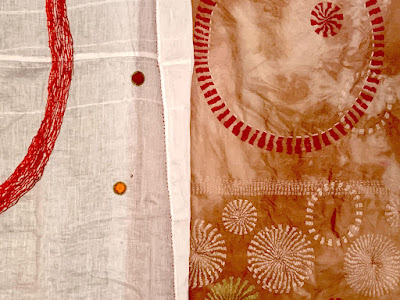
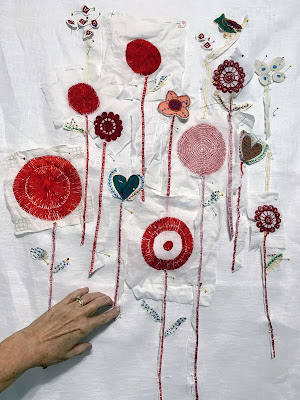
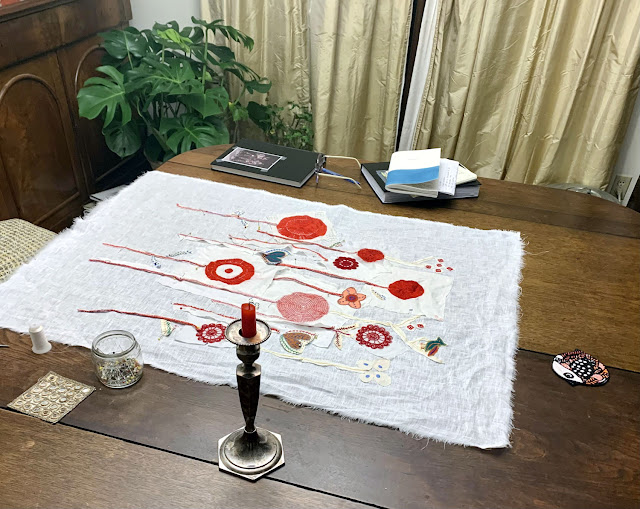
Embroideries I made in a younger time,

for a different project,

are cut and re-arranged into a garden,
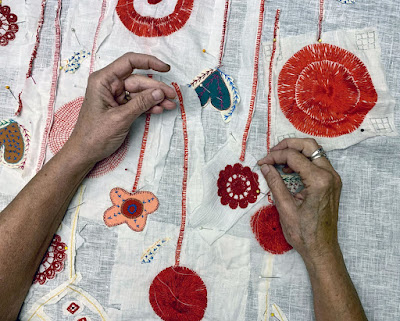

stitched to new cloth.  

Seeing them being reborn enlivens me.  

enlarges my spirit. 


This new work is round and bright

and fragile and soft.

Stitching it, making it

helps me to accept the winter coming

and my ageing 
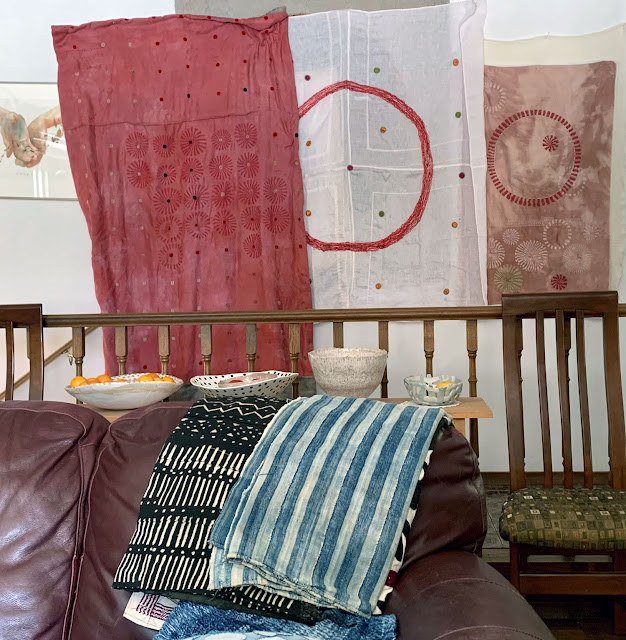
I have been stitching new circles

one after the other.

Bowls of silence.  (Rumi's words)
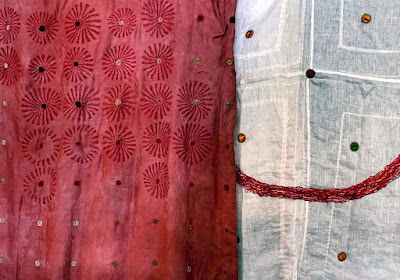
Circles and dots

that represent Gaia's rhythm.

The natural cycles of the sun and the moon and the planets and the stars

and how they relate to earth. 

Cosmic time pieces.

The earth revolves on her axis in one day,

the moon orbits the earth in one female month,

the earth orbits the sun in one year.

Gaia rhythm.

Earth clocks.

under the blue sky my clock-faced flowerbeds reflect the orb of the sun

they never sleep

lying awake under the starry constellations, they listen to the music of  time.

they chuckle, yes they chuckle 

and gossip.
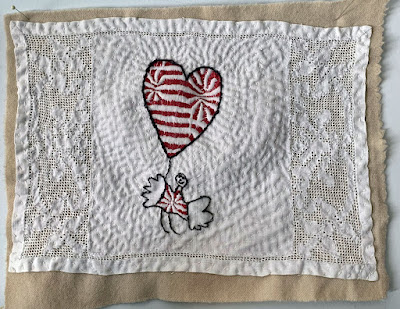
I walk in this garden holding the hands of dead friends  

Old age came quickly. 

Cold, cold, cold, they died so silently.
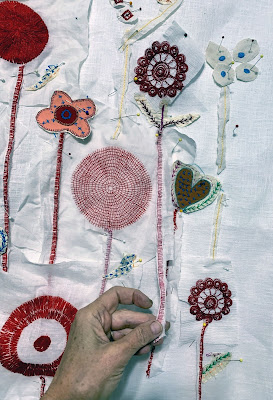
My gilly flowers, roses, violets blue, 

sweet garden of varnished pleasures, 

please come back next year.

                                                                  Derek Jarman

Wednesday, April 08, 2020

Do you know what a symbol is?

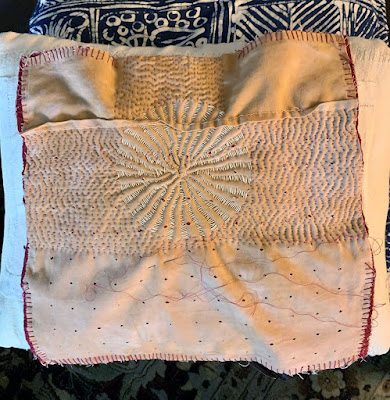
I've been absorbed with assembling a piece from vintage funeral wear.
Doing this helped me come back to and appreciate ordinary daily life.
The time before this pandemic crises seems like from another world. 
What was important for me at the beginning of March seems trivial now. 
My priorities and concerns have completely changed.
I've been having scattered disjointed thoughts, moodiness, despondency, weeping, and anxiousness.
Stitching into pieces already in progress (such as this one) helped immensely.
I reasoned that if I died, finished quilts would be easier to deal with. 
I'm still not able to do my real (usual) work - but I will someday.
This project was cathartic.
There was no warning that I would make this artwork.
It came all of a sudden and was a release.

Thursday, October 31, 2019

The Path of the Heart: Lenore Tawney

To be an artist, you must be brave.

You can't let yourself be scared by a blank sheet of drawing paper or a white canvas.

But what you put on that paper or canvas must come from your deepest self.
To discover this place is our aim and our goal.

Your attitude of openness toward this place in yourself can be like the thick layer of leaves on the forest floor, in that it is always there, no matter what goes on above.
Our instinct drives us downward to the source; there we have visionary experiences made visible.
This can be what motivates you to keep on what I call The Path of the Heart
This path and the seed of your own work are within each one of you.

(her work smock)
One thing I must tell you: what we most try to avoid in life is, in fact, our greatest teacher
- that is pain, anguish.
This pain and this anguish, take us off the surface of life and into the depths where the treasure lies.
This is your life, dear friends.
Meet it with bravery and with great love."   Lenore Tawney
(the black coat she wore to her openings)
The text in this post is Lenore Tawney's commencement address to the graduating students of the Maryland Institute College of Art in 1992

The images are from my visit to the exhibition Mirror of the Universe at the John Michael Kohler Art Center in Sheboygan Wisconsin.   The main exhibit remains up until March 7.  Cloud Labyrinth comes down January 19 2020.    I have written about this exhibition with more clarity on Modernist Aesthetic.   go see. xo

Friday, March 02, 2018

the healing machine

the healing machine , individual component, baling wire, aluminum foil
This post is about Emery Blagdon's Healing Machine.

the artist believed that his art could cure people
When Emery Blagdon was 48, he started building the healing machine and continued for 31 years until he died in 1986.  He lived in Nebraska and created an environment in a shed creating sculptures made of baling wire, aluminum foil, hand-painted lightbubs, salts, and bright paintings of geometric shapes.
Blagdon believed he was sensitive to electrical current and was investigating the curative powers of  this unseen force.  He hoped that the objects he made might ease human pain and suffering.
Portrait of Emergy Blagdon with his works in progress by Sally and Richard Greenhill 1979
In 1979, a couple from England, Sally and Richard Greenhill, came to Nebraska to photograph the artist.
view of Emery Blagdon's shed with installation of more than 300 hanging and standing sculptures made from bailing wire and aluminum foil
After his death, Emery Blagdon's work was collected together by his friends, including Dan Dryden.  The Kohler foundation acquired the work in 2004 and after conservation, it became part of the John Kohler Arts Center's permanent colleciton.  This includes the workshop and 400 constructions, paintings, and other components.  It is on view until July 1 2018.
It is fascinating that he had the idea that static electricity and its emanating aura would cure those who experience both physical and emotional suffering and so created these fantastical objects.
painted light bulbs

painted wood with nails and thread
His paintings of concentric circles and angualr lines seem to generate power and reflect it outwards.

the healing machine indvidual component, baling wire, wood, aluminum foil sculpture by Emery Blagdon
Astonishing
Here is another article about this artist, and an audio.
a visionary art environment
I was most attracted to the sculptures that used masses of repeated small and interesting shapes.  These were carefully placed within each of the "pretties" (his word for the individual components) so that they channel the earth's natural magnetic energy.  Read more here.
I had to go experience this exhibition twice and still walked away in awe.  

Saturday, January 26, 2013

Joseph Cornell

Untitled (Butterfly Habitat) 1940 construction by Joseph Cornell (1903 - 1972)

In Greek and Japanese symbology, the butterfly refers to the soul.
Untitled (Paul and Virginia) 1946-48, detail of a construction by Joseph Cornell. Inspired by a romantic story of a young couple who found happiness on an island.
Museum, 1944-48, construction by Joseph Cornell.  In each small bottle is a tiny object.  The label in the lid lists them. (watchmaker's sweepings, souvenir of Monte Carlo, chimney - sweeper's relic, Mayan feathers, white landscape, etc)  
Swiss Shoot the Chutes, 1941, a game construction by Joseph Cornell.  A collage of the map of Switzerland is cut into to reveal little figures.  When a small wooden ball is dropped in one of them at the top corner, it strikes twelve bells one at a time as it descends the ramp.
Toward the Blue Peninsula (for Emily Dickinson), 1953, white painted construction by Joseph Cornell.  
Dovecote, 1952, construction by Joseph Cornell.   Cornell made a series of Dovecotes in the 1950's, where formal order and purity is offset by the element of play.  The three balls can roll around inside the interior. 

Joseph Cornell's use of the grid, of the dot which is a hole, of the idea of revealing or keeping safe at the same time, and the element of chance and play have been inspirational for my own work.  Like here, here and here.

Source of images in this post:
 Joseph Cornell, Master of Dreams by Diane Waldman

Monday, April 19, 2010

all that is required is to slow down and reflect

I spend a lot of time alone.

I read the art reviews, the concert reviews and the movie reviews in the Toronto Globe and Mail and realize how isolated I am. (Manitoulin does not have a movie theatre)

“Ned” I say. “My work is backwoods, its out of step.”

He responds, “I don’t know Jude, where IS the centre of the universe?”

So that’s the title of the talk I'm giving on Friday.

Thursday, March 27, 2008

a wrapped package

I created this shadow box after reading about Louise Baldwin in an old (2002) Embroidery magazine. I was freshly inspired when I read about her use of collections and how she considers the idea of 'the curator'. Why do we place things on a mantelpiece. What do the odd things collected in boxes, bowls mean? What do we decide to save, what do we decide to throw away? What kind of story happens by placing images and objects next to each other?