Showing posts with label Canadian Artists who work with Textiles. Show all posts

Tuesday, November 17, 2026

World of Threads 2026 part 2


Victoria Carley September (Sky Over Lake) dynamic piecework and a limited palette are used to express a view of an autumn lake, peaceful and also alive. 


Kathleen Vaughan. The River’s Threads. Cyanotype and Embroidery, naturally dyed surround, text in English, French and Kanien’keha ( Mohawk) .  


Meshell Melvin  invocation to the chinook of Chu Miikwan embroidery, laser cutting, installation of multiple parts, using big magic to call the formerly abundant population of salmon home.  


Meredith Jones it is not, not finished  red thread  cross stitch on rice paper, displayed with a light box, the stitching is deliberately left unfinished as an act of resistance.  


Kae Sasaki untitled (floor globe)  reclaimed Japanese glass beads, vintage globe, embroidery, reclaimed materials and slow process invites quiet reflection on endurance, interconnection and the beauty of what remains.  


Sarah Spencer the magician appliqued and machine quilted portrait.  One of several quilt portraits that act as love letters to rebels, individuals who fearlessly share their unique spark with the world. 


Loretta Faveri Clementina Sauro handwritten text on paper, torn and sewn.  During WWII 600 Italian Canadians were interned by the Canadian government under the war measures act.  One of these was the artist’s grandfather, who’s five sons served in the Canadian forces.  His wife wrote letter after letter advocating for his release, Loretta transcribed the letters and then tore them into small pieces and used the pieces to create portraits of her ancestors.  Seen as shadows projected in the wall.  


Tuija Hansen the garden sustains us and the garden nurtures hand woven plant dyed wool with supplemental weft on a digital loom.  Gardening is woven into her family heritage.  Gardens are a source of grounding and resilience through personal crises. 

Sunday, November 15, 2026

World of Threads 2026


Melanie Chikofsky multiple organisms- arched and pierced  Japanese paper sculptures

Cocoon shapes that the artist created during the introspective period of the pandemic.  


Sheila Thompson Leaves: an impression comprising six leaves  wet felted   This installation takes up an entire wall.

Super-sized leaves as they might appear in 2050, after absorbing generations of environmental upheaval.  


Marguerite Larmand glacier calving painted willow and hand made paper

As the planet warms, the glaciers respond by releasing more melt water into the oceans.  


Carolyn Murphy the lookout. Pieced and quilted fabrics.  This installation takes up an entire wall.  

The dense and living velvet of the forest floor near a Quebec lake.  


Bear Epp a silent cry hand hooked 

About the changing landscape of Prince Edward County, Ontario, the barn owl is now endangered.


Carole Baillargeon paysage de sol; ground landscape  embroidery natural dyes 

Looking down at the surface we stand on.  


Susan Avashai alone in the universe  machine constructed and embroidered quilt.  “How should we live if this luminous and fragile planet is all we have? “


Carolina Gama the exile appliqué and stitch on stained domestic linen.  A portrait of her most vulnerable self, holding pain in quiet isolation.  


Diana Fox-Revett chaconne hand-pieced and then appliquéd quilt.  


Ursula Oberholzer la Ribambelle. A garland of 100 unique knitted dolls, each dressed carefully and with supreme originality, an expression of unity through the simple gesture of holding hands.  


A post about ten Canadian Artists who work in textiles and have work on display at the World of Threads festival this fall.    World of Threads continues until mid-January 2027 and most of the 192 artists in the exhibition are from Canada.  I’ll post about ten more Canadians soon.  

More information about the World of Threads is on their website.  

Monday, October 26, 2026

Sandra Brownlee


Sandra Brownlee was born in Fredericton, New Brunswick in 1948.  

She studied at the Nova Scotia College of Art and Design in Halifax Nova Scotia and then in Cranbrook Academy of Art in the USA where she received a MFA in 1981.  

She won the American Pew Fellowship in 1991 and the Canadian Governor General's award in 2014.

Sandra is a weaver and became renowned for her white and black spare abstract wall pieces. See here.  She spent many years as an educator and exhibition artist in the USA.  She returned to her home in Dartmouth, Nova Scotia in 2005, and continues to maintain her studio in Canada. 

Sandra has kept notebooks through her career, and the connection of sewing to text is a longtime concern for this gentle and thoughtful artist.  I wrote about her notebooks on this blog in 2014.  See here. 

Meaningful Words, annealed wire, 2025-2026

Sandra has a solo exhibition in Halifax, Nova Scotia at the Blue Building gallery in the autumn of 2026, entitled The Word Made Physical.  The exhibition focuses on her tactile notebooks and continues until November 7.  

“Whenever I need to understand something, connect to something, I sew,” Brownlee says while explaining how her style of hand-embroidered text developed. She traces it back to a trip to India in her early career and struggling with what to write in a letter to her husband: “I had a pen. It ran out of ink, so I got my needle and thread out, and I sewed the rest of the letter, and when I sewed the letter, I knew what to say,” she says, explaining that “rhythmic making” like stitching or weaving has “allowed me to connect, to access thoughts, feelings, memories, and ideas, specifically through the sewing. So that's the seed of The Word Made Physical. By making it physical, with a thread, the needle, the floss, in and out, up and down, I was able to express myself in a sincere and unselfconscious way.”   From the CBC interview by Morgan Mullin

 Canadian Artist who Works With Textiles 

Sunday, May 17, 2026

Maria Hupfield : Jingle Spiral


Maria Hupfield was born in Parry Sound, Ontario, Canada in 1975.  She works across disciplines such as video, performance, and industrial felt.  After ten years of living in Brooklyn, NY, Maria has returned to Canada, and resides in Toronto. She identifies as an urban Anishinaabe who belongs to the Wasauksing First Nation (Huron Robinson Treaty) in Ontario.

Jingle Spiral (2015) (pictured above) references the Ojibwe sacred powwow dress.  Such dresses feature hundreds of metal cones that creae a soothing sound when the dancer moves.  In her 2017 exhibition at the Power Plant in Toronto, Jingle Spiral was presented mounted on the wall as well as in a performance video. Watch the video at this link.

Maria Hupfield is assistant professor in Indigenous Performance and Media Art at the University of Toronto in Mississauga where she runs the Indigenous Creation Studio and is also the Director and Lead Arrtist in the Department of Visual Studies / English and Drama.  As well, she works with graduate students at the St. George Campus of U of T.  Hupfield states:  "My research brings together studio based practices and processes with expansive definitions of art that are informed by knoweldge from nations connected to the campus in the Great Lakes region."  

Maria Hupfield is number 9 in the Canadian Arists who work with Textiles series.  

Friday, March 27, 2026

Mary Scott: Shredded Painting

Shredded Painting, unwoven canvas, by Mary Elizabeth Scott

Mary Scott is a Canadian artist who was born in  Calgary, Alberta in 1948.  

Mary Scott holds a BFA (1978) from University of Calagary and an MFA (1980) from Nova Scotia College of Art and Design.  She was assistant head to Banff visual arts from 1982 - 1984, and then began teaching drawing and painting at the Alberta College of Art and Design, retiring in 2012. She refused to accept the paintbrush as the only way, and in the 70's and 80's, used a syringe to apply paint to alternative surfaces.  Around the same time, she started to incorporate text into her work and words by Gertrude Stein and Luce Iragary are featured in some pieces.  Scott's work is in several major public collections including the National Gallery of Canada.  

In you more me than you Mary, safety pins and acrylic, no date, by Mary Scott
collection of Owens art gallery, New Brunswick

The impact of feminism in the 70's and 80's encouraged women artists to look at traditional women's craft and reinterpret it into pieces that were gallery worthy, full of content and skill.

Imago (viii) "translatable" *is That Which Denies*,
by Mary Scott, embroidery and unwoven silk, 1988

Mary Scott's feminist work is based on reading and there are layers of meaning in her work.  Her labour intensive techniques include shredding cloth or removing the weave of various fabrics, embroidery, gold leaf, wrapping, crochet, and painting/writing with a syringe.  Mary Scott's fabric and text-based paintings heralded the emergence of post modernism and feminism in Canadian art.  

number 8 in the series:  Canadian Artists who Work with Textiles

Tuesday, January 13, 2026

Dorothy Caldwell: Listening for the Quiet Sounds


Listening for the Quiet Sounds by Dorothy Caldwell, 6 x 9 feet, 2023
 
Dorothy Caldwell was born in Bethesda, Maryland USA in 1948.  
She moved to a rural acreage in Ontario, Canada in 1972 and continues to lives there with views of several hills, farmers' fields, and a lake.  In 1990, she won Canada's highest award for fine craft, the Saidye Bronfman Award, (a Govoner General Award).  Caldwell's work is adored, exhibited, and collected around the world.  

Listening for the Quiet Sounds (detail) by Dorotny Caldwell
Earth pigments screen printed onto cotton  with ink washes, applique, stitching

Dorothy Caldwell was trained as a painter, and graduated from the Tyler School of Art in Philadelphia with a fine art degree in 1970.  Textile art was not yet an option in art schools but in 1974 Caldwell attended the World Craft Council conference in Toronto entitled In Praise of Hands and saw global hand crafted objects and textiles.  These inspired her to open her painting practice to new materials and technques.  She has since travelled the world studying and also teaching tradtional and innovative ways to mark cloth in a contemporary, abstract manner that feels timeless.
  
For more information about Dorothy Caldwell, a good summary of her career is here on Grokopedia.  You can also watch her speak about her artistic journey at this link. and learn about her study of earth pigments on Fibre Arts Take Two.  The article I wrote about her work on Modernist Aesthetic in 2014 remains number one of all the artists I've profiled.

Dorothy Caldwell, number 7 in the list of Canadian artists who work with textiles.  . 

Friday, October 31, 2025

Tina Marais: Unfolding

Unfolding 2022 by Tina Marais

Le Petit Mort 2022 by Tina Marais

Tina Marais was born in South Africa, August 1977.

She moved to Canada in her early 30's, and became a Canadian citizen.  Currently the artist is living in Lyons, France. 

Harnessing the Power of Fear by Tina Marais 2020

In her youth in South Africa, she studied visual art (painting, drawing) at university and then, following her natuarl affinity for all things textile, she studied pattern drafting and worked as a costume designer.  

In Montreal, Canada, she needed to learn French and aquired her Masters of Fiber and Material Practices from Concordia University in 2019.  During the pandemic, she was diagnosed with breast cancer and went through several treatments. 

Her artwork reflects with enormous imagination and tactility her courageous life story.  One of the best articles about this artist (among many on the internet) is here: Tina Marais Struthers: Life in Fibre.   

Tina's art is internationally acclaimed. Her powerful sculptural textiles have shown in biennales and invitaional exhibitions around the world.  One of the first artists interviewed by Fibre Arts Take Two (here) Tina Marais is currently teaching Soft Revolution for this organization.  

Numbr 6 of Canadian Artists who Work with Textiles

Friday, September 19, 2025

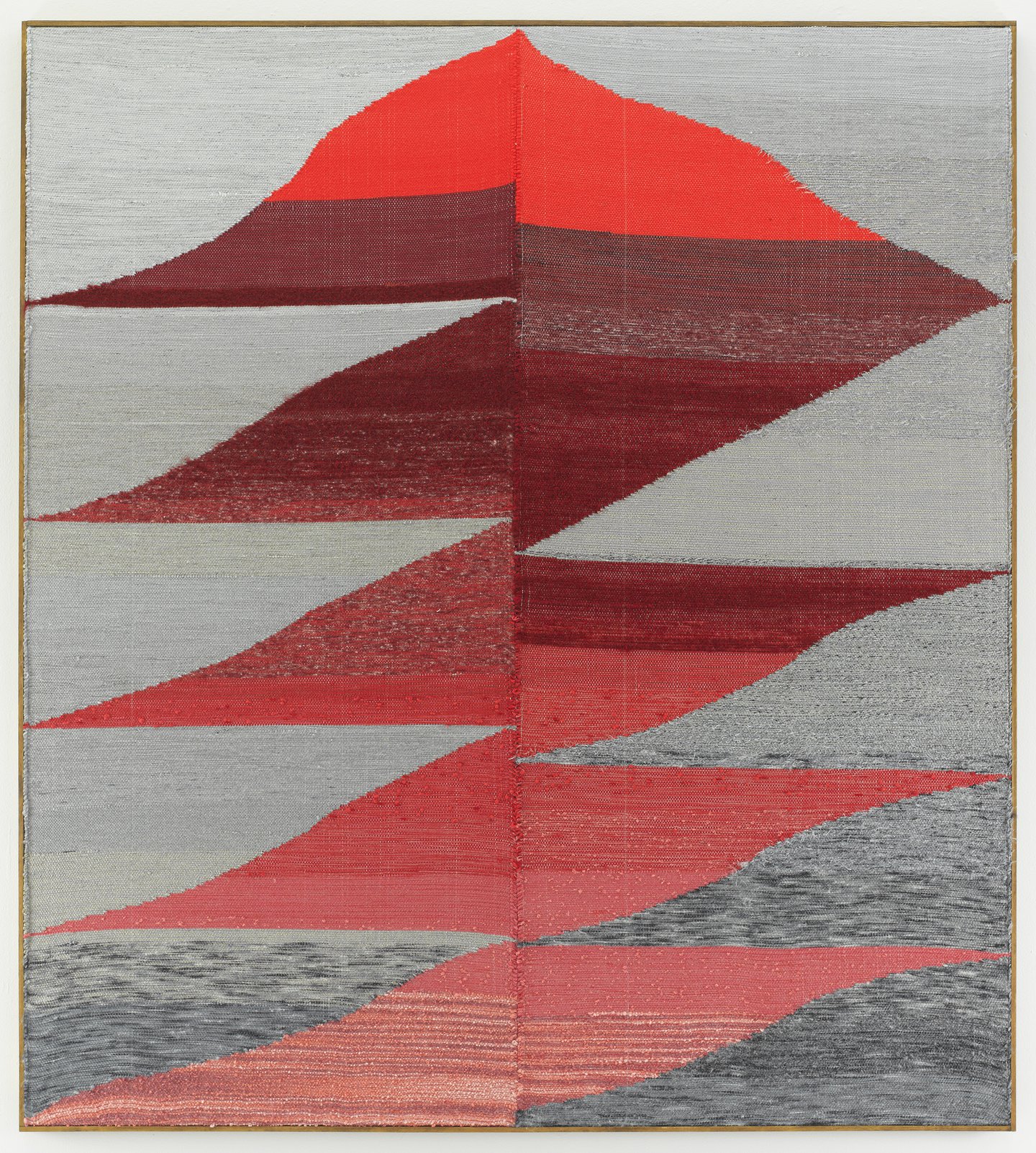
Brent Wadden: Untitled (pink/grey)

Untitled (pink / grey) by Brent Wadden  Handwoven fibres, 79 x 71" 2015

Brent Wadden was born in Glace Bay, Nova Scotia, in 1979.

If you look him up on the internet, he comes up as Brent Wadden painter.  His BFA degree from the Nova Scotia College of Art and Design (NSCAD) is in painting.  "Friends commented on how much my work resembled textiles or how it would translate very easily into a weaving, and that planted a seed"  so that when he saw an exhibition of vintage Morrocan rugs in 2010 it "totally blew my mind".  The large weavings were hung vertically on the wall rather than flat on the floor,  and Wadden was drawn into the psychedelic nature of the lines and patterns.  He liked "how the patterns and colours just started and stopped randomly"  At the time Wadden was living and working in Berlin, Germany and the artist-weaver Travis Meinolf lived nearby.  Meinolf kindly started Brent with some yarn, a back strap loom, and rudimentary lessons.  It wasn't long before a hybrid artform of woven fibres assembled and then  mounted on stretched canvas became Brent Wadden's primary medium. 

He has had many solo exhibitions in Europe and in North America.  He uses second hand yarns and threads, and concentrates on large jagged abstract forms.  This focus on form melds the aesthetic gender and status roles associated with craft and abstraction.  The resulting paintings have both a structural life and a planar presence.  (Mitchell-Innes and Nash art gallery)

Brent Wadden now divides his time between Vancouver Canada and Berlin Germany.  

Further Sources:  Emergent magazine , Pace Gallery, and the book Cloth :100 Artists by Lena Corwin

Number five of  Canadian Artists who work with Textiles.

Monday, July 28, 2025

Joyce Wieland: I Love Canada ~ J'Aime Le Canada


 Joyce Wieland :  I Love Canada ~ J'Aime Le Canada


Joyce Wieland  (1930-1998) is considered to be one of Canada's most prominent and prolific artists. 

The youngest of three children, she was born in Toronto, Canada to English emigrants who died when Joyce was quite young.  Brought up by her siblings, she attended high school at Central Tech in Toronto and was mentored by artist Doris McCarthy, who taught there.  She began her work career in film animation and met artist Michael Snow, marrying him when she was 26.  In 1960, (age 30) and then again in 1962, she had solo shows in two separate Toronto commercial galleries.  1962 is also the year that she and Michael moved to New York and lived there for nine years.  While in the USA, she became more aware of politics and of her deep love for  her home country, Canada.  When Pierre Elliot Trudeau became prime minister in 1968, she celebrated that by giving him a bed sized quilt, inspired by his mantra, Reason Over Passion.  Read more information about this two part piece that mixes the personal and the political at this link.   Wieland and Snow moved back to Canada in 1971 in time for her to mount her solo exhibition, "True Patriot Love" at the National Gallery of Canada. The exhibition included quilts and paintings, most about the fragile arctic and expressing a deep love for Canada.  Joyce's older sister Joan Stewart along with friends and volunteers joined with Joyce to sew the quilts she designed for this ground-breaking exhibition.  

I Love Canada ~ J'Aime Le Canada    cloth, thread, batting, metal.  Joan Stewart did the quilting and the embroidery.        1970   collection of Mackenzie Art Gallery, Regina, Canada. 

"Wieland believed that Canada had to extricate itself from US encroachment.  Subverting the myth of a peaceful, tolerant, caring, and just Canada, the small embroidered letters in the middle read:  "Death to U.S. Technological Imperialism" in both official languages.   Wieland's progressive vision of Canadian society saw anglophones and francophones reconciled.  she declared in a 1971 New York Times article "I'm a Canadian.  I believe in Canada.  We should work for Canadian unity - English and French - as Canadians, not as anti-Americans.  We should be more positive about ourselves."

Joyce Wieland is being honoured by a full career retrospective in 2025.  It showed in Montreal in the first half of the year and in Toronto at the art gallery of Ontario in the second half.  There is a catalogue available entitled Heart On.  

Number 4 of Canadian Artists Who Work With Textiles  

Sunday, July 13, 2025

Anna Wagner Ott


Shield:  threads, yarns, tyvek, acrylic paint  31 x 36 inches 2023  


Unfurling:  tyvek, yarn, thread, masking tape, acrylic paint
48 x 24 inches  2024


Anna Wagner Ott

Anna was born in England and emigrated to Canada at an early age.  Her art education includes degrees from University of Toronto and University of Alberta and a PHD in art education from Penn State.  She taught art at California State University from 2000 - 2013.  Her work has been displayed in multiple solo and group exhibitions. Her studio was in Barry's Bay, near Ottawa, Canada.  She was a prolific maker and showed her work as well as the process of creating it almost daily on the social media platforms of facebook and instagram.  She was a constant participant in international exhibitions such as Canada's World of Threads.  Anna Wagner Ott passed away suddenly and quietly on Christmas Eve 2024, a great loss to so many who had come to love her through her work.

"In the process of creating, I endeavor to connect with the pain of loss and insecurity, the act of concealing truths, the inherent vulnerability of life and death, and the inevitable process of disintegration and impermanence.  Yet, I also seek to capture the sparks of beauty that often emerge with the transitions and fading away.  My art serves as a continuous effort to piece together fragments of my own experiences, sometimes building up my weavings, and at other times deconstructing them - a symbolic reconstruction of my psyche, a continual process of destruction and reclamation of myself."

Her daughters wrote on Instagram:  "Anna was a true artist.  Art wasn't just what she did, it was who she was.  While she was also a devoted wife of 55 years, a loving mother to her children, an Oma to her 7 grandchildren, a sister, an aunt, and a friend, her life's purpose was clear, she was here to be an artist.  Her death was unexpected and we are still processing its suddenness."  

Because of the internet, there are many places that we can view her work and listen to her voice.  Two good ones are her own website, Anna Wagner-OTT and the fibre arts take two interview from 2022. 


Loving Red:  yarn and wax, 4 feet wide, 5 feet tall  2022 by Anna Wagner OTT

Monday, May 26, 2025

Janice Wright Cheney: Widow


Janice Wright Cheney

Janet Wright Cheney's life-sized bear, Widow, is armoured nose to paw in felted woollen roses and a velvet hide.  She is beautiful, but strangely so.  She even seems aware of her strangeness, questioning - how did this come to be?  It's partly in her posture.  She stands up on her hind quarters as bears do to sniff the air, seeking the lay of the land, puzzled.  She seems caught in an ongoing moment of self-bewilderment - an appropriate attitude for the grieving, for whom the balance of the whole world has shifted, making every day into a question.                                                                                                                                      The bear has a fairy-tale quality, connoting Sleeping Beauty, hidden behind a wall of roses.  But rather than a pre-adolescent waiting to be woken and learn the ways of an adult lover, this is an adult learning to live with the loss of her life partner.  As a widow-bear, the line is blurred between human and animal as fairy tales so often do, brothers metamorphosing into swans, frogs into princes, Wright Cheney's bear is implied to be living out a gendered grief, culturally ascribed, one that seems more human than animal.  Though on the other hand, grief is a wild emotion, one that may well turn us into some bearish version of ourselves.   read more of Sue Sinclair's review of Widow here  
The artist says:  "I saw a dead bear on the side of the highway, curled up like it was sleeping.  The sight of it filled me with a terrible sadness.  I thought, who mourns for this bear?  Who loved this bear?  My work Widow is the bear that is left behind, the bear that grieves.  This work explores the impossibility of reconciling love, and desire, with death.  So it had to be big:  it had to be a grizzly bear, because I wanted to express the enormity of grief." 

Janice Wright Cheney lives in Fredericton, New Brunswick where she continues to make art and also teaches at the New Brunswick College of Craft and Design.    Click here to view her website. 

This is the second post of a new series on this blog.  

Monday, May 12, 2025

Frances Dorsey: Shot Through The Heart


Frances Dorsey

When Frances Dorsey was seven to ten years old, she lived in Saigon, Viet Nam.   She remembers "a paradise on the edge of conflagration".  When she was twenty-one, she moved to Canada.  She has a duel citizenship with USA.  "I am a citizen of North America."

This piece, Shot Through the Heart, is made from used table linens that have been naturally dyed with extracts and earth oxides, as well as discharged and immersion dyed with mechanical resists.  Some have been  over printed with silk screen and also with block printing. The linens were cut up and reassembled.  They were embroidered hand stitched.  It is a large piece:  11 feet x 11 feet.  It was made in 2010. 

Suzanne Smith Arney saw this piece at a conference in Nebraska in 2010, and wrote about it in the fall 2011 of the Surface Design Association's journal.

"The napkins and tablecloths are soft with age and use.  Looking closely, I can make out a nine-block structure, with those blocks subdivided into four.  Each discovery revealed another level to decipher.  Stepping closer, I read the fabrics' histories written in monograms, embroidery, as well as small tears and stains.  Dorsey added her own text in faded yellow, red and purple dyes.  There are folds and stitchings and photo -derived images of her father's army photos and letters, such as b-52s and mortars.  I read the title and stepped back.  Shot Through the Heart infuses the room with a chilly clarity; the whole and partial circles are no more suns than dinner plates.  They are targets."

Frances Dorsey taught about textiles at the Nova Scotia College of Art and Design for sixteen years.  Her father was a rifleman "who relived his combat daily."    She currently lives in Halifax, Nova Scotia, Canada and continues to make thoughtful and beautiful artwork with textiles.  

This is the first post about a new series on this blog:  

Canadian artists who work with Textiles