Showing posts with label Manitoulin Island. Show all posts

Friday, September 26, 2025

Goldenrod dye

This is a record of what I did to process wild goldenrod from the ditches and fields of Manitoulin into a brilliant yellow or gold dye on cellulose (linen and cotton) materials.  The method I use takes days.  My bible was Sara Buscaglia's book, Quilt Alchemy.   The fabrics were scoured, soaked in tannin, mordanted in alum, and finally dyed in a liquid made from cooking goldenrod flowers or goldenrod leaves and stems.  I'm sharing what I did because it might be helpful to others, but please remember that I am not an expert. I learn something new every time I do this.  

September 13.  Gather the wild material.  Ned and I had a lovely afternoon, driving the back roads of this beautiful, rural place.

September 14.  Separate the flowers from the green stems and leaves. 

September 15.  Cover the plant material with boiling water and allow to steep overnight.

September 16  Simmer the plant mixture for one hour.  Allow to steeep 8 hours. Repeat two more times.  

September 17:  Continue to simmer and steep.  I had four large cauldrens going, taking turns on my kitchen stove.  Two with just flowers and two others with only leaves and stems.  It takes days to extract the colour fully.  Some say that you can over cook the flowers and make the colour dull.  Maybe I did, I'm not sure.  

September 18:  Meanwhile, prepare the fabrics by scouring them.  To scour linen, immerse in hot water that has one tablespoon of liquid soap and two teaspoons of soda ash per cauldren.  Simmer for one hour and then allow to cool in the liquid.  Rinse.  I prepared six linen damask table cloths for the first strike of dye.  

September 19:   Mix tannin solutions.  This important step is what helps the cellulose accept the colour.  I used powders from Maiwa for this step.  Myrobalan, Henna, and a Tannin that I bought twenty five years ago and never used.  The Myrobalan gave a yellow tone to the cloth, the Henna gave an yellow-orange tone to the cloth and the 'tannin' gave a pink-tan tone.     

I made six buckets of tannin pre-soak in total, two of each type.  I only put one table cloth into each pail because it is important not to over-crowd.  Recipe: I used 4 talblespoons of tannin powder and 1.5 tablespoons of soda ash in a 2.5 gallon bucket of hot tap water (a stronger solution perhaps than I needed).  Immerse scoured, rinsed, and wrung out cloth into the pail.  Make sure there are no air bubbles and the fabric is under the surface.  Allow to cool,  steep over night.

September 20:  Mix alum mordant solutions.  4 tablespoon alum (potassium) and 2 tablespoon soda ash in larger bucket (5 gallon) of hot water.  Stir.  I made three alum buckets.  By this time I had a dozen pots and pails in total.  Thank goodness that it was beautiful weather and I could work on the deck.

Have a pail of luke warm water handy, and rinse the tannin-treated cloth in the clear water before wringing it out and putting it into the alum mordant.  When recipes say to soak two hours or overnight, I always do the overnight option because this is very physical work and my body just need a break.

September 21: Time to dye!  For the first time in my dyeing with natural dyes, I didn't heat the colour.  I just strained the flowers off and filled two buckets with dye colour made from flowers only.  After rinsing the alum soaked cloth, I immersed it inito the dye, and pushed out all the air pockets that might make it float to the top.  I left them to steep overnight along with the buckets of leaf and stem colour. 

September 22:  I wrung out the table cloths without rinsing and put them on the line.   Meanwhile, I had discovered a large stack of already scoured cotton and linen.  It was soaking in the bath tub, and this day was spent re-charging the tannin buckets and adding these fabrics to them.  

It is necessary to re-charge the tannin after each use.  Recipe: heat up the solution on the stove to the temperature of hot tap water, and then add 1.5 tablespoons of tannin powder and 1 heaping tsp soda ash.  You can re-use your tannin three times.  

flowers only in first six pieces, stems and leaves in the furthest away four pieces

September 23:  I left my fabrics on the line overnight and then put them through the dryer so that I could fold them up without worrying about dampness.  I didn't rinse or wash, but i did dry them.  I usually leave my cloth a month to allow the colour to cure.  

When that much time has passed or when I am ready to use it, I wash it with synthropol liquid soap. 

September 24 and 25:  I continued re-charging the tannin pre-soaks and also the alum mordant pails.  To recharge alum, heat up the liquid and add 30 percent of the powders.

After processing cotton and linen fabrics, I began working with (protein) wool and silk fabrics. Protein fabrics do not need the tannin pre-soak, but the advice is that they do need the alum to be brightest.  

In the evening of September 25, I hung the wool and silk fabrics on the line and Ned and I then disposed of the tannins and the dye liquids.  They were exhausted by now and the colour was becoming pale. 

I have a lot of yellow fabric now.  I hope to create green with some of it by overdyeing with indigo. 

Saturday, December 10, 2022

aesthetic pleasure

 
I have been procrastinating about writing anything this month.    


I will share some photos 

of the layers of linen and wool and sheer that I have been stitching with black and red thread.


It seemed so urgent that I stitch every day.

I thought I might get this one finished.   I told myself that finishing it was why I was stitching so much.

But that was not true.  

I was stitching so much because I was letting my own hands do what they do so well. 

My hands take care of me.


These past weeks, I read essays by women in old magazines and attended panel discussions on Zoom.

I went into my town studio a lot, and came home by the back roads, 

because the trees and ditches take care of me too.


In the essays,  I kept coming across words like care and nurture and support and retreat. 


The water in the lake is beginning to freeze.  

Can you can see the misty fairy hair?.


Aesthetic pleasure is important now, not just for its own sake, but to revive us, to give us the wherewithal to fight another day.      Aruna d'Souza             Canadian Art winter 2019


This piece is called Inner World. 

I'm finishing it up for an exhibition next spring.  All the work in the exhibition is two-sided.  

Most of the pieces are made by stitching first on one side and then another, 

and when they are displayed,  the 'other' or the inner side faces outwards.   

Inner World


Art has begun to feel not like a respite or an escape, but a formidable tool for gaining perspective on troubled times.                       Olivia Laing         The Guardian     April 2020


Stitching helps me because, for the several hours each day that I spend stitching, 

real time is stopped.  

The whirl of it.  The fear of it.

Making my art is like being in a zone of enchantment.
  

Whatever brings the consciousness into a state of pure attention, in a time of perplexity, will also give back an answer to the perplexity.          D.H. Lawrence  1928

The stars.

The sky and the stars.


In current climates, the act of taking time out of our day to make, time to look after yourself, time to be with loved ones, is important.  Modern quilting is all about time.  The moments we share with one another and the processes we choose to adopt to take care of ourselves.                                                    Julius Arthur           Embroidery Magazine      July/August 2021


There's a lot going on with my kids these days.  

Inner World

The title of the exhibition is Inside Out.  

Mark making is a way to make an effect on our own world.                                                          Margaux Williamson             Canadian Art     Winter 2019 


Art is an articulation of resilience.                                                                                                      People create art through war and pandemics and hardship and the work lives on for hundreds of years.                                                                    Tatum Dooley  The Guardian     April 2020                 

Tuesday, November 22, 2022

Anong Beam

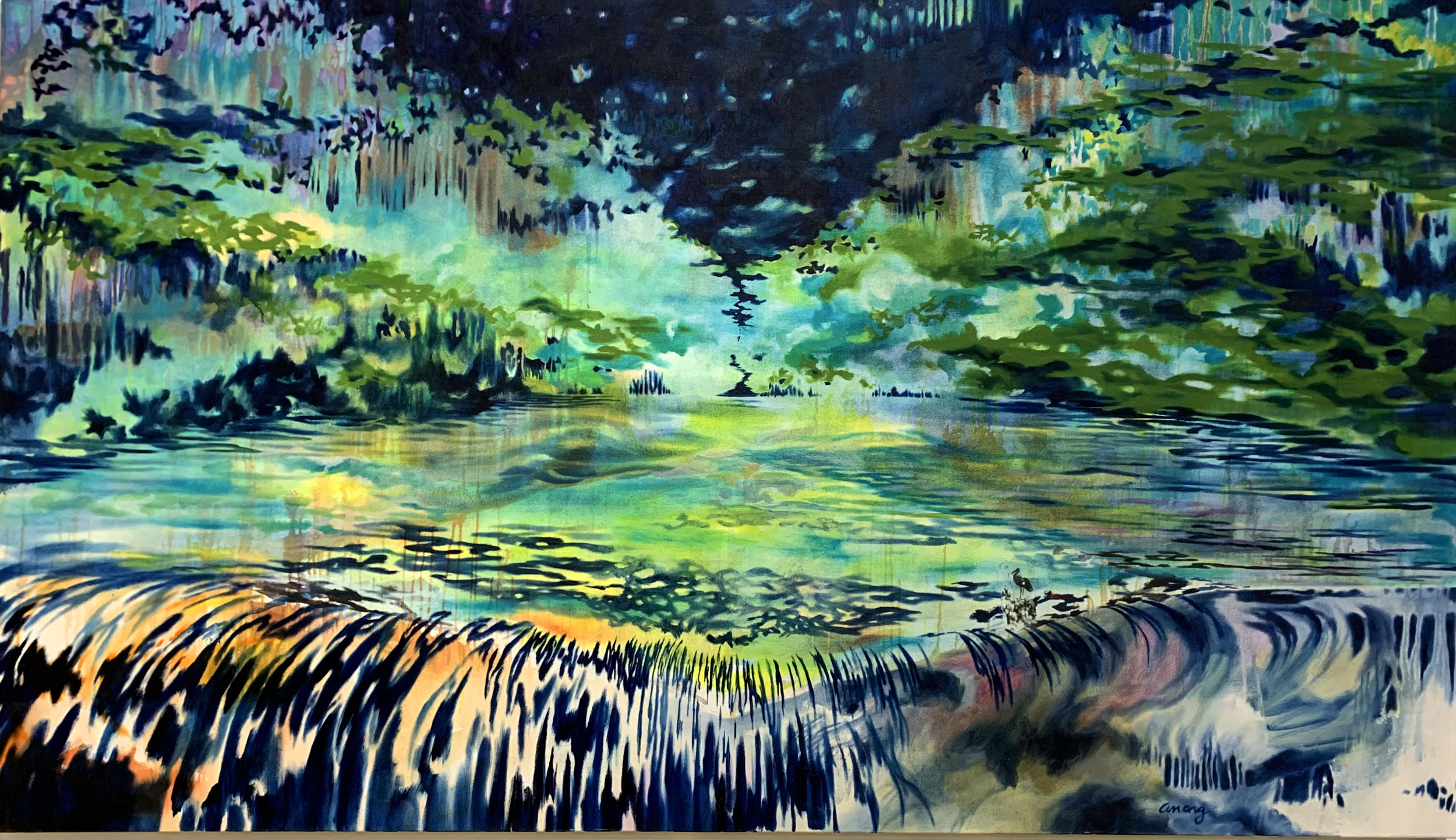
Spring Bay, Mennonite Barn, oil on canvas, 2020 by Anong Beam

Looking at my life, and with my mother entering Alzheimer's' I have been painting memories.

My practice has always centered around water and how it holds and contains us, and is a silent witness again and again to all events, constantly renewed and present in us, as it was for our ancestors.

Ghost Moose and Camp, oil on canvas, 2019 by Anong Beam

But now I am looking back and I feel like I am reclaiming histories for myself.  

I am inspired by other histories of place like Camp Forestia by Peter Doig.  It is a classic camp from the Ontario north, there are many all around me, and they are completely other.

I have memories of seeing people go to them.  They are the settler camps, even though they are so familiar.

They are a visual image of privilege and isolation.

Camp Cadillac oil on canvas  2018  by Anong Beam

All around my home, even on reserve, the waterfront belongs through long term lease to non-native families, who have held them for years.  These paintings are emerging to reclaim images of where I live, and to relate them back to me.  It's strange to live somewhere and be of a place so fundamentally, but seeing it depicted only in a way that isolates my culture.


Mountain Lake oil on canvas 2018 by Anong Beam

It is this medium and genre of oil on canvas.

Sections of Tom Thomson's West Wind, and his Jack Pine, appear with Doig's Camp Forestia, alongside a ghost moose, myself swimming in the lake, my boat in Swallow Lake at first snow.

My father's recurring image of a rocket launch, birds and birds and birds!

An old Cadillac, fireworks, lakes, birds, bears, and the stars.

It is just immensely pleasurable to rectify this even if it is just in  my paint-world..  I love these painters as well and hold them no ill will!  Peter Doig, Tom Thomson, Kim Dorland, these men are painting their lives, and I am grateful to live in a time and place where I can do the same.


Beaver Dam Overflowing, oil on canvas 2018 by Anong Beam

Also, reaching deeper into art history, I'm happy to explore painting devices from Matisse (table with pansies, the joy of life) Botticelli Birth of Venus, Rothko's colour pairings, Georgia O'Keefe's skulls, and Agnes Martin's grids which influenced my father, back into me, into dancing elk herds.

It's really something to be the child of a famous artist.  It's intense, and I've seen so much of the art world that is unkind, and unhealthy.  I've seen my mother's pain inside that she was not recognized like her husband.  

But all that pales in the joy that I feel creating these landscapes, internal, wishful, desirous, wanton, exploding!  In some real ways they are ecstatic love stories to paint.

Deluge, oil on unstretched canvas, 2019 by Anong Beam

Being the first series where I have made all of my own oil paints, there is an incredible circuity to making paint from rocks from Bay Fine near Killarney, then painting that same scene with those rocks that are now paint!

Each image that I make I feel and I fall immersed in the history of painting, learning devices from those who have already travelled this path.

Miigwetch.

Anong Beam

detail of Deluge by Anong Beam

The text in this post is Anong Beam's powerful artist statement for her exhibition:  Anong Migwans Beam at Campbell House.  It was curated by Elka Weinstein.  I saw the show in July 2022 when it travelled to Manitoulin Island and was mounted in the Ojibwe Cultural Foundation. 

I admire how Anong has addressed the huge issue of white settler colonization / indigenous land and human rights with these multi-layered paintings.  These paintings appropriate subject and style of white male artists' paintings of iconic Canadian scenes.  Make no mistake.  This beautiful and tender and luscious work is also political. 

Monday, October 17, 2022

Autumn Song

We closed our cottage on Thanksgiving weekend, just Ned and myself.

We got there around 2 pm on the Saturday.  It was very blustery. 

I started a fire in the kitchen stove and he started one in the fireplace.

We had an early simple dinner.

I had my holy Rothko piece with me.  

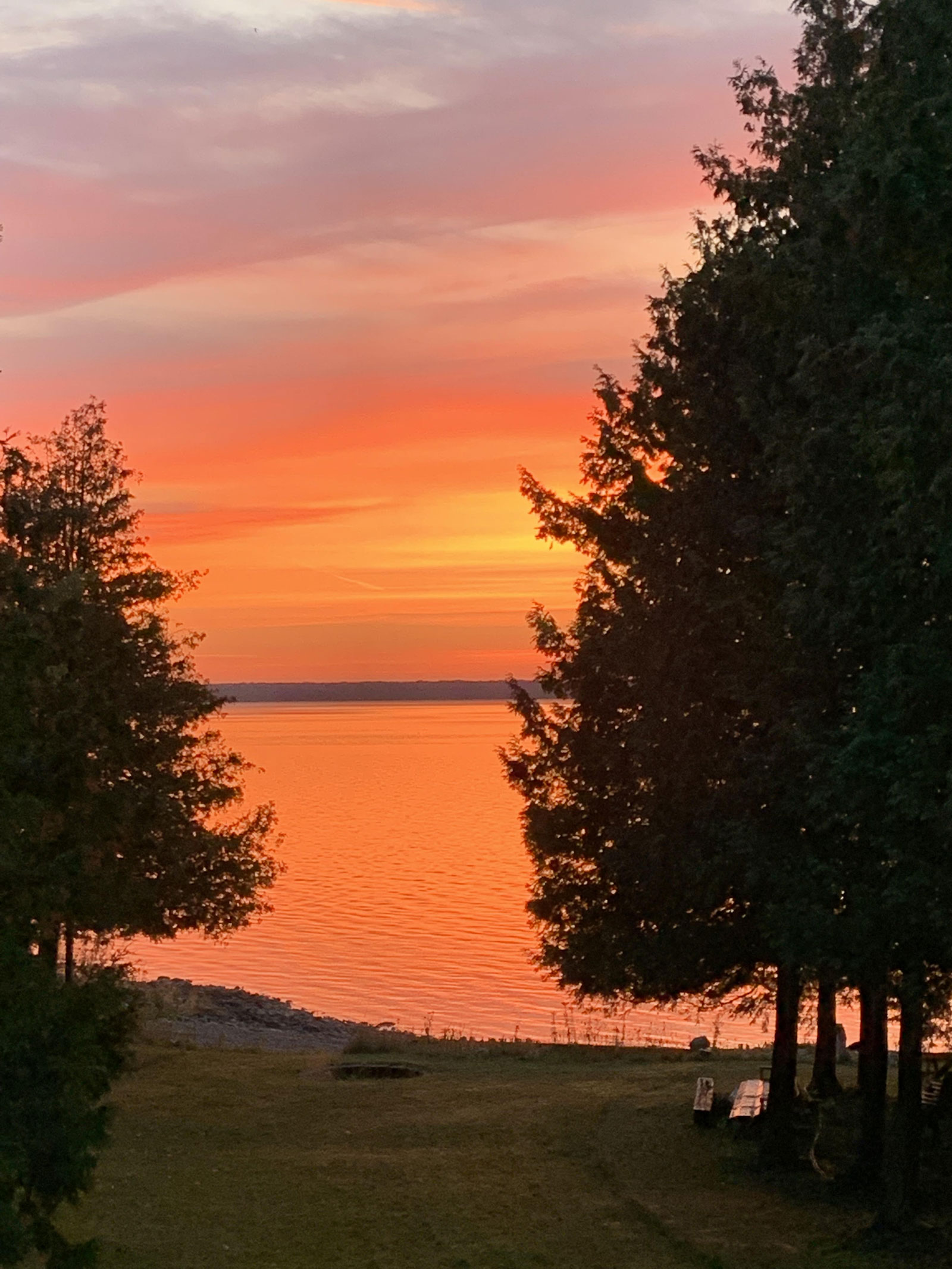
I am thankful for the angle of the sun that makes the water sparkly at 5 pm

and for all the pillows, blankets and quilts that I prepare for winter storage

and for my teacup of gin and for Eleonor Wachtel on CBC radio. 


Ned wore his red toque all day and night and I wore my undershirt.    

We have started into our 50th year or marriage. 

On my mind is the spring 2023 exhibition.  

To help me plan, I have been writing out the measurements of the walls   

and pinning different pieces up to see how they look together.

I want to choose a collection of work that is beautiful but also a bit raw.

I want my exhibition to be like a poem that reveals an inner self full of love and emotion and worry. 


I stitched my red Rothko piece by the fire both nights. 


Meaning in art often comes from the materials it is made from.

Repetition is a material.

The over and over gestures made by the body calms the maker.

The sight and feel of the repeated marks soothes the viewer.


On Monday we finished up and drove into the setting sun with the boat on its trailer.   

We were home in time to see the  moon rise.

and the next day's sunrise 

Why do you stand at the window abandoned to beauty and pride

the thorn of the night in your bosom, the spear of the age in your side?     
Leonard Cohen.

Circles, red thread, domestic textiles, ancient marks, 

whirling spirals, grids, time, dream and the vulnerability of sleep.

All of these are in this work of mine.  What do they mean?


And what does it mean that there are two-sides 

and that I work the marks from the back? 


The first thing I did in this piece was to dye it red.  

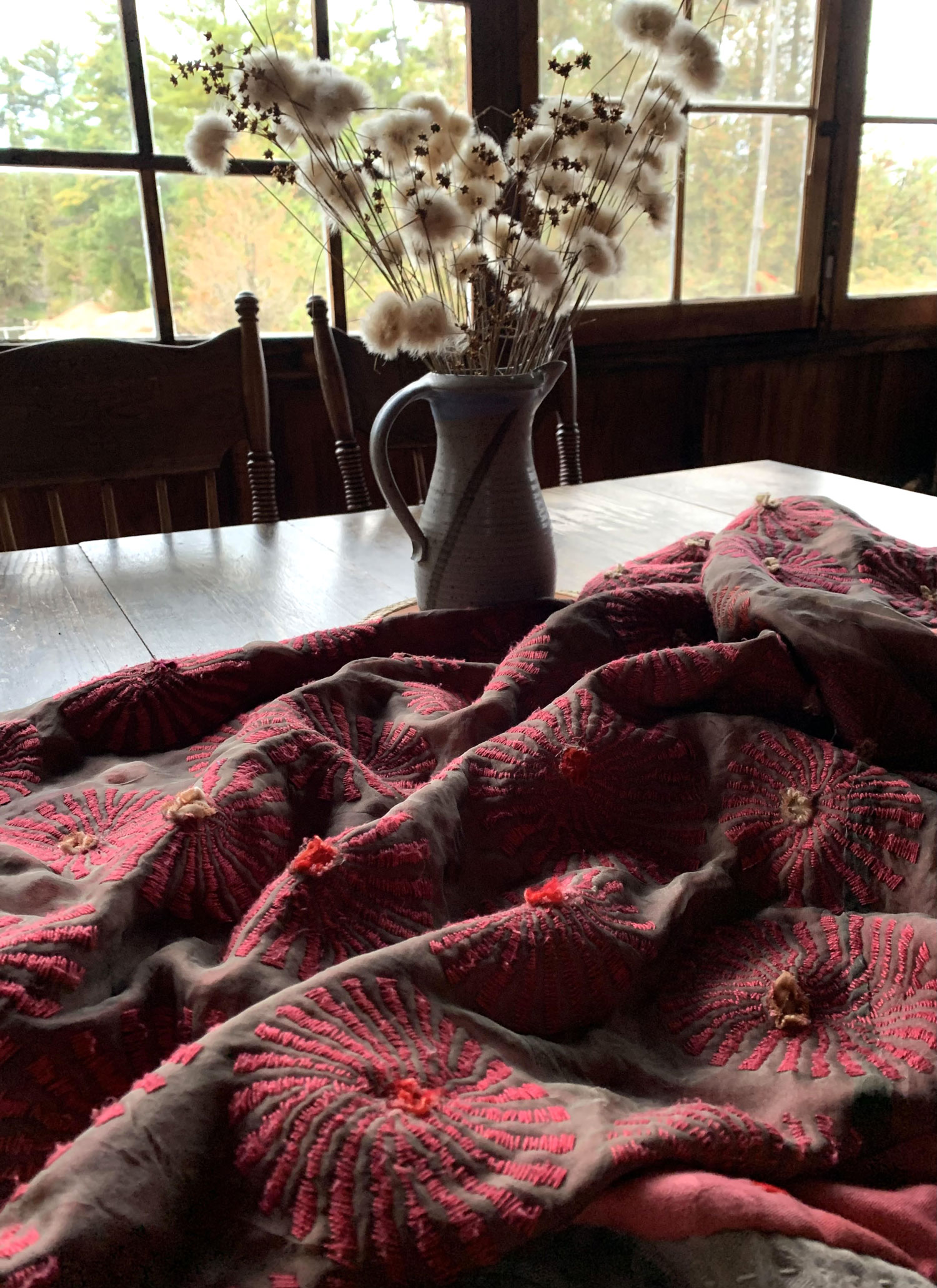
It is a full size linen damask table cloth.  I made holes in it with a kind of acid.  

This was in 2011.  See here. 

then in 2020 I planted velvet in each hole with reverse applique.  


A garden of dots arranged in a grid, like Agnes Martin's idea of perfection. 

"it is not in the eye, it is in the mind. In our minds there is an awareness of perfection."  


Now there is a layer of dark sheer fabric covering the reverse side. 

And I am stitching circles around the reverse dots using a running stitch.

The stitches get smaller and smaller as you go around.   

It takes time.


When I finish, I clip the sheer cloth away and the velvet is set free.  

The raw edges flame into petals that stand up from the base cloth.  

This work is about finding a way to meditate. 

These repeated circles help me to feel my own spirit.


This work doesn't address the outer world.

(There is a war going on that we fear any day will turn nuclear.

There are school shootings, children are being killed for no reason.

There are floods and hurricanes and fires that ruin people's lives for years.)


My circles do not fix these things.

My circles do not comment on these things. 

They do not try to convince people.

These circles are a way to find emptiness and calmness.

I was sad because I was alive.  I did not even know all the things I wanted, and that is what made me saddest.  If I were more religious than I am, I might say that the feeling was yearning for the place we came from before we were born. 

Perhaps instead, it is about the human search for perfection, the perfection we find only in great works of art and out in the landscape.  Sharon Butala

I think that we yearn for perfect peace, which doesn't mean being in perfect solitude, but for peace in the heart.  A peaceful heart in the midst of the multitudes, tumult, chaos, violence, sorrow, and beauty of everyday life.  We can never have that peace.  (Except in a work of art or in the sunset we have intimations of it.)  That is why we feel sadness.  Sharon Butala


 I will continue stitching these flowery circle stars.    

Carry on bravely my friends. xo  

Wednesday, August 11, 2021

Not stitching, grand mothering

It's queen anne lace time on Manitoulin 


I've just spent two weeks at Ned's family cottage.  I had some lovely grand mothering time there 
I also stitched when there was a moment.  I want to finish this wool blanket piece for my exhibition with Penny and Miranda coming up this fall.  
Before the children arrived, I spread my work on the lovely dining room table and worked for several hours late into the evening.
I also worked in the early mornings, before anyone else woke up.
Now I'm home on pastoral Manitoulin, and am loving the different kind of natural beauty in the fields.
Q:  How many days left do we have?  (the 4 year old)
A:  Do you mean here, at the cottage?  Eight.
Q:  No.  How many days does the world have?
A:  Oh.   Pause.  Lots and lots.
Q:  54-hundred, 11-13, 44 million trillion?
Before I came to the cottage, I added four borders to a piece that I thought was finished in 2019.  
It was not finished.
I've named the piece Medicine Earth.
Sometimes the girls had sleep overs in my sleeping cabin.  I got up early and stitched.
Here's a song that the  7 year old and I wrote before we went swimming: (tune Down by the Bay)

Aili picked up her towel
Grandmom finished her coffee
Aili put on her boat coat
Grandmom took off her housecoat
They went to the stairs
(Grandmom used her cane)
Aili got there first
Grandmom got there just the same.
(the four year old)  Grandmom?  What will you be when we are grown-ups? 
(the seven year old)  She'll be dead! 
(the 70 year old)   I'll be 92.  (and looks at the 7 year old with raised eye brows.)
(the seven year old, nodding her head)  You'll be 92....maybe 94.  (apologetically)
Now I'm home on Manitoulin, but going back to do more grandmothering next week.
By the way, now Medicine Earth is finished.
I work slowly and that slowness is very brave.
Because time is much faster.  Time whizzes.

Here's another song composed over breakfast:
  
Maia had a zig zag bed
She zigged and she zagged when she went to bed
Zigging zagging to the top
Zigging Zagging, now she stops.
Up so high nearly in the sky
Waving down from her zig zag bed.