Showing posts with label dorothy caldwell. Show all posts

Tuesday, January 13, 2026

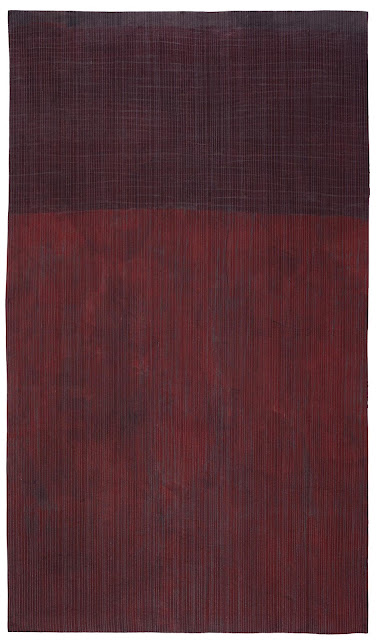
Dorothy Caldwell: Listening for the Quiet Sounds


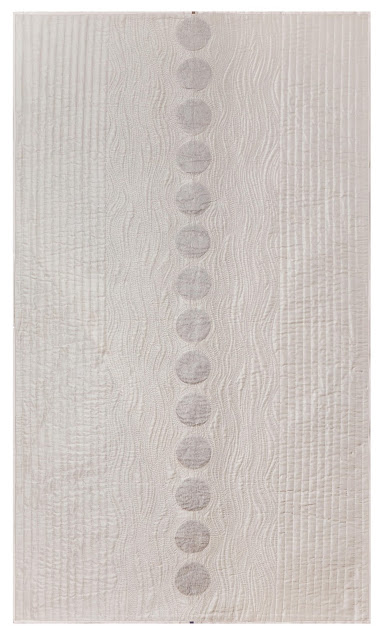
Listening for the Quiet Sounds by Dorothy Caldwell, 6 x 9 feet, 2023
 
Dorothy Caldwell was born in Bethesda, Maryland USA in 1948.  
She moved to a rural acreage in Ontario, Canada in 1972 and continues to lives there with views of several hills, farmers' fields, and a lake.  In 1990, she won Canada's highest award for fine craft, the Saidye Bronfman Award, (a Govoner General Award).  Caldwell's work is adored, exhibited, and collected around the world.  

Listening for the Quiet Sounds (detail) by Dorotny Caldwell
Earth pigments screen printed onto cotton  with ink washes, applique, stitching

Dorothy Caldwell was trained as a painter, and graduated from the Tyler School of Art in Philadelphia with a fine art degree in 1970.  Textile art was not yet an option in art schools but in 1974 Caldwell attended the World Craft Council conference in Toronto entitled In Praise of Hands and saw global hand crafted objects and textiles.  These inspired her to open her painting practice to new materials and technques.  She has since travelled the world studying and also teaching tradtional and innovative ways to mark cloth in a contemporary, abstract manner that feels timeless.
  
For more information about Dorothy Caldwell, a good summary of her career is here on Grokopedia.  You can also watch her speak about her artistic journey at this link. and learn about her study of earth pigments on Fibre Arts Take Two.  The article I wrote about her work on Modernist Aesthetic in 2014 remains number one of all the artists I've profiled.

Dorothy Caldwell, number 7 in the list of Canadian artists who work with textiles.  . 

Saturday, September 16, 2023

Minimalism

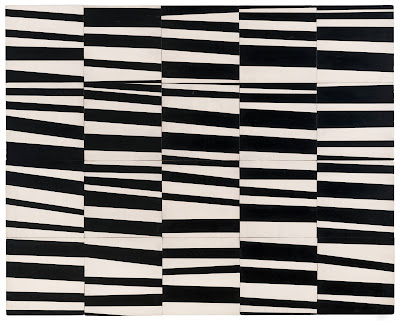
 Cite by Ellsworth Kelly 1951  oil on wood, 20 joined panels, 56.5 x 70.5 inches

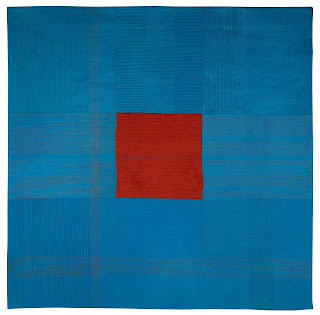
There is a SAQA global exhibition of quilts premiering this weekend at the Carrefour in Alsace France.  It is entitled Minimalism and it was juried/curated by Dorothy Caldwell.  

Dorothy wrote a juror's essay at the beginning of the catalog that reminisced about her visit to Jonathan Holstein's exhibition of American Quilts at the Whitney Museum of American Art in 1971 when she was an art student and the dominant Abstract Art Movement of the time was Minimalism.  

In her essay,  Dorothy named key artists of the Minimalist movement such as Ellsworth Kelly (top image), Agnes Martin (see the two images below) and Donald Judd (see his wall sculpture in the next photo).  I apologize for the quality of these images, I got them from the web.
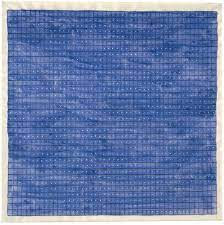
Summer by Agnes Martin 1964  watercolour, ink, on board and paper, 72 x 72 inches

 
Buds by Agnes Martin 1959  oil on canvas, 50 inches square

Minimalism emphasized geometric shapes, stripes, grids, solid colours and truth to materials.

When Dorothy Caldwell attended the Whitney show in New York, she writes in her essay that she had an epiphany.  She realized that quilts are minimalistic and that the quilts in the exhibition, (made by anonymous women) were stunning, sophisticated art.  She could see that quilts embodied Minimalism's essence.  

"This was a turning point, and I moved on from painting to textiles.  The Minimalist tradition inspired making art where the material carries the message."  Dorothy Caldwell
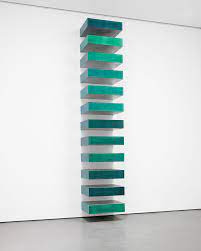
Untitled by Donald Judd 1967   lacquer on galvanized iron, 12 units each 9 x 40 x 31 inches


The Minimalist Movement of the 60's and 70's acknowledged material in its original form.

"Jurying SAQA's Minimalism exhibition was an invitation to revisit the Minimalist Movement.  The experience allowed me to consider Minimalism's relevance today, as manifest in contemporary art quilts.  It is refreshing to experience honest qualities of cloth.  Multiple interpretations of Minimalism, in the dynamic world of the art quilt, will challenge viewers to experience a movement rooted in the 1960s in a thoroughly modern context."  Dorothy Caldwell

Although there are 43 artists included in this exhibition there is space enough for only six in this post.  Please visit this link to view all of them.  (A printed catalogue is available from SAQA)
 Solitude by Margaret Black, USA, cotton and dye,
straight line machine quilted, 69.5 x 40.5 inches 2021

Seeking Simplicity: Threads 3 by Lynne Seaman, UK,  cotton, dye, fusible web, 
machine embroidery/quilted with coloured threads 25.5 x 25.5 inches 2022

Quilt Drawing #25 - String of Breaths  silk, hand embroidered and hand quilted
59 x 34 inches 2021

Polder Horizon by Petra Fallaux, USA   cotton, dyes, mono printed, overdyed, 
machine pieced and machine quilted  67 x 43 inches  2021

Total Solar Eclipse by Jeri Auty, USA  cotton, layered and pieced
machine quilted 47 x 31.5 inches 2022

Ode to Jan by Marjolein van der Eijk, Netherlands, cotton sateen
machine stitched and quilted, 36 x 36 inches 2022

I have a piece in this show.  Please see my update blog. There is also a photo of my quilt in the sidebar of this blog.   
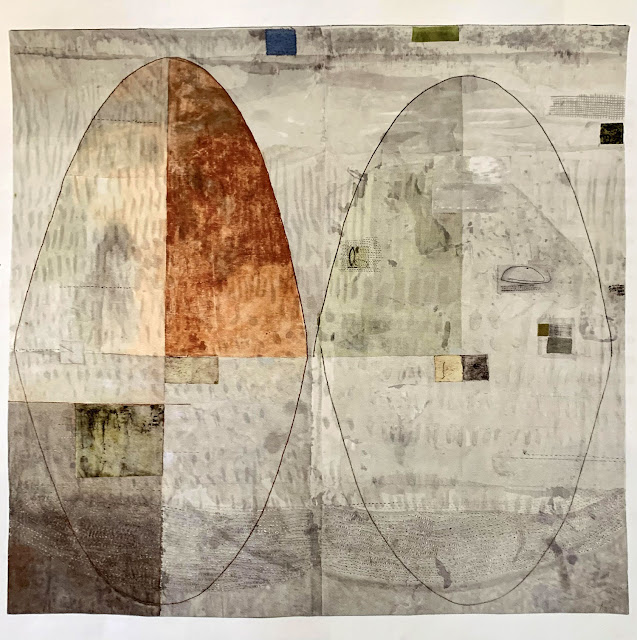
A Red Hill A Green Hill by Dorothy Caldwell,  cotton with ink wash and earth ochre,
hand applique and hand stitched, 9'4" x 9' 8"  2012


The Minimalism exhibition will travel for three years.  It's in France right now, next stop Italy, so I hope that many of you will have an opportunity to view it as it travels to a gallery or festival near you.  

Friday, August 21, 2020

Anna Torma / Dorothy Caldwell

A Red Hill/A Green Hill 2012 by Dorothy Caldwell
 ink wash, earth ochre on cotton with stitching and applique, 284.4 x 294.6 cm 

This post highlights two of my Canadian heroines and their beautiful philosophies about making.

In this interview with Dorothy Caldwell  Dimitri Papatheodorou of the Art Gallery of Northumberland in Cobourg Ontario visits Dorothy in her studio this summer. (2020).  The two discussed her touring 2014 exhibition Silent Ice Deep Silence and the research that went into creating the work for it. 

Book of Abandoned Details  2018 by Anna Torma
cotton, silk, hand stitched 136 x 135 cm

The next video is a conversation with Anna Torma and is presented by the Esker Foundation, Calgary Alberta in honour of her 2018 exhibition there, Book of Abandoned Details

A Red Hill/A Green Hill by Dorothy Caldwell, earth ochres and hand stitch detail

It's been difficult for museums and art galleries (and for artists) during this pandemic time.  Closures and now appointments and mask wearing make the gallery experiences challenging for everyone.  

Dorothy Caldwell is one of eleven artists curated into an exhibition entitled Cloth Constructions at the International Quilt Museum in Lincoln Nebraska this winter by David Hornung.  Here's the link. 

Book of Abandoned Details 2018 by Anna Torma
hand stitched cotton and silk  136 x 136 cm

Anna Torma's solo exhibition Permanent Danger was hung but the gallery had to close before the opening ceremonies last April.  It has since re-opened at the Museum for Textiles in Toronto Canada and has been extended until March 2021.   

Congratulations to these artists and to the curators who have have championed them.  Textile art is best when you can see (and yearn to touch) it in real life rather than on a screen or printed in magazine or book.    Let's try to visit art galleries again and be nourished.

Thursday, January 12, 2017

Dear Dorothy Caldwell

Dorothy Caldwell  Canyon 2012   stitched cotton earth ochre 13 x 17 inches 
Dear Dorothy

I just finished reading the article in the recent SAQA journal.  It is very well done and I believe that it respects your work and long career.  Congratulations.  
Dorothy Caldwell  detail of Canyon
I very much enjoyed reading it and re-visiting the large pieces from Silent Ice / Deep Patience,
Dorothy Caldwell Before the Glaciers Melt plant dyed with stitching and applique 14 x 17.5 inches
I visited the David Kaye show just before it closed in December and spent a good long while with your work there and with talking to David about our favourites in the show and about some of his own history as a textile artist. 
Dorothy Caldwell detail of Before the Glaciers Melt
I photographed most of the pieces and plan to put up a blog post about that exhibition soon.  (Thank you for your permission).  Also, may I use the quotes by you that are in that SAQA article?   
Dorothy Caldwell  Looking Up / Looking Down  2016  dyed in the Australian outback with iron oxide and eucalyptus printed and stitched cotton, 55 x 59 inches
One thing that I noticed in the new work at David Kaye Gallery is the amount and variety of the hand stitched marks.  
Dorothy Caldwell  detail of Looking Up / Looking Down
Do you agree that there is more stitching in these new pieces than in previous work?  I love the way that you draw with a couched line - and how sometimes just the wrapping threads have been left behind from a removed thread, evidenced by a line of dots.      
Dorothy Caldwell detail of Looking Up / Looking Down
 Masterful.
Dorothy Caldwell   New Growth in Pink Earth   2016  stitched cotton, pink earth ochre  17.5 x 15.25 inches
 In the article, you mentioned the difference beteen a painter's gestural mark and a stitcher's smaller and perhaps tighter hand muscle mark, and how you are  seeking ways to make energetic marks. 
Dorothy Caldwell detail of New Growth in Pink Earth

Dorothy Caldwell   detail of New Growth in Pink Earth
I shall carry this (energetic) idea forward into my own work in hand stitch. 
Dorothy Caldwell  Silent Fog / Listening  2016  stitched cotton with ink wash  11.25 x 14.5 inches
 I also responded to the quote about how you initially view your work with despair but also are grateful for the flaws and mistakes as they give you a place to begin...to repair.  
Dorothy Caldwell  Crossing the River 2016  plant dyed and stitched linen 12.5 x 9.25 inches
 Thanks for both these inspirational ideas.
Dorothy Caldwell  Outcrop  2012  stitched cotton with earth ochre  13 x 17 inches
 "A stitch is a mark like any other mark.  It is a dot, a line, a texture.
One of my questions is how the mark made with a needle and thread is similar to or different from a drawn or painted mark.
The act of stitching involves the small muscles of the hand while seated.  In contrast, a painter may use his or her entire body to make a mark.
I often think about how to make an energetic stitch - a stitch with a sense of gesture."
Dorothy Caldwell
Dorothy Caldwell detail of Outcrop 
Happy New Year! 
x
Judy