Showing posts with label dots. Show all posts

Saturday, March 14, 2026

foundation pieced circles


A diary 
I worked on this blue piece for nearly 3 weeks.  The plan was to make a circle from triangles. Foundation piecing gave me security.  Drawing the shapes onto a base cloth and then using the stitch and flip method gave me freedom.  Sharing here with humbleness. 


Feb 22:  First I pinned a cotton sheet to my pin-wall that would be my master life-sized drawing. Using a washable marker, I traced around a circular tablecloth. This is the size I want my finished circle to be.  

Then I cut out tissue paper triangles intuitively. I made enough tissue paper triangles to go around the diameter of the circle and pinned them to the wall. The short fat triangles on the left were the size I used.     


Feb 24:  I had been hoarding this dotted fabric and was excited to use it. The triangles were cut out one at a time and pinned to the wall.  It took a couple of days just to cut and pin.  


Feb 25:  Once I had all the outer triangles cut and pinned to the wall, it was time to cut fabrics for the narrower inside triangles that would be used to join them together.  I had to make a decision about whether to use more dotted fabric for the inner triangles or use contrasting fabric.  I made more tissue paper patterns.  I looked.  I made decisions. 

Feb 28:  I sewed all the triangles by hand and was able to create a complete circle.  As I sewed two together, I pinned them to the wall and continued looking and considering.  

March 1:  I moved everything onto the table.  

March 1:  With a washable marker I began to fill in the circle.  My idea is to use concentric rings of triangles and work my way to the centre.  The first ring is three inches wide.  

I traced along the inside edge of the sewn triangles and then a second line 3 inches in.  Within those two lines, I drew triangles to fit the curve.  I did not measure these triangles, but trusted my intuition.  All drawing was directly onto the bedsheet.

March 2:  Using a separate piece of cotton gauze fabric, I traced the triangles.  This is my foundation pattern. Use a lightweight see-through fabric for your foundation cloth.   (The gauze I use is available here .


March 2:  Stitch and flip through the drawn lines on the foundation fabric. I made four curved gauze patterns with the traced triangles on them.  

To guide my cutting and to be frugal with my hoarded dotted cloth, I made tissue paper patterns for the triangles.  A fatter -based one for the outer triangle and a thinner -based one for the inner triangle.   


March 4:  I was soon able to sew the inner curve to the outer curve.  (by hand of course)


March 6:  The two outer rings of a large circle are now pieced.  I might continue making foundation rings of triangles and work my way to the centre.  I'm not sure anymore.  


I was so happy creating this, but the amount of activity in the white dots on the blue base challenges my pared down aesthetic.  I’m putting it aside to steep for a while.  

Wednesday, November 12, 2025

How do I begin?


I think the process starts with my place on this island and in my personal relationships.

I think that those two things are the ground for every thing I make.


I respond to my yard and the trees and the water and the sky

and the drive home with the sun going pink 

and the quietness 

and the feelings of safety that Ned provides.

I also look at books.

I read the words.

I read every day and do so because of the lovely words, one after the other.

Evocative words, well placed, that connect to something wordless in me.

I can't really explain it, but they inspire me.


Sometimes I write them down but most of the time I just absorb them.  Other people's written words.


I look at art books.  

I have a big collection of books on art, quilts, world texitles.


I look at the pictures in these books.  I study one or two pictures a day.

Every day. They feed my creative brain so much.


So that's where I start. 

That's where the ideas glimmer.

When I feel any kind of spark, I make a quick note or a sketch in the journal I keep close. 

I don't really draw.

I don't need a drawing, or want one.  If I had a drawing of what the completed piece would look like, then I wouldn't be able to make it.


I think that a refined drawing would stifle me.    

I do make quick and rough sketches with a ball point pen.  

The photos that illustrate this post are of of some of the quilts I worked on in October. 

Gratefully.

Friday, September 13, 2024

her vision grounds me

Stoney Island Memories 2019

Working alongside Penny Berens is one of the highlights of my career.  Noticing how she maintains her own heart felt vision helps to keep me grounded.  

It's easy for me to find artists in books who seem to know their own selves and are able to write about their making process and belief systems, but Penny is a real person with whom I can speak with on the phone.   I just spent nearly a week with her in Nova Scotia when we installed and spoke about our joint exhibition, In the Middle of the World. 

Resting Between Tides 2019

She notices details.    

Her work is drawn with needle and thread in her lap.  She does one artwork at a time. 

Each of her pieces is directly influenced by some particular event or sight or feeling that she has experienced.

Walking on Stoney Ground 2019

There's nothing general about her interpretations, although her works do have an atmosphere.

Our work complements each other because of the differences between our two approaches as much as because of the similarities.


When Autumn Leaves Fall 2017


Winter's Edge 2021

The large scale of my work makes an immediate impact on the viewer.  

My work communicates a lasting feeling of spirit and intimacy.  It sets you up to receive the details and imagination of her wall pieces, as you slowly move past them, one after the other.  
    
Details of Winter's Edge

You are ready to notice the details and the events and the change of seasons in her interpretations of nature.  

Also the boulders and the piles of smaller rocks.

The sun and the moon.

The wind and the beaches.  The grasses and the berries.

All the small repetitive marks that nature paints in the bush or on the beach are detailed in Penny's work and it is interesting to experience them, step by step, with close observation.

November Song 2024

detail of November Song


She says that she wants to work more abstractly and messier. 

The last thing she said to me when we hugged good bye was that she was going to start doing this right away.  She's five years older than I am and neither of us are going to retire.

I'm glad that she's only a phone call or a text message away.  She keeps me on track.  She encourages and inspires me.

Beaver Moon Dreaming 2020

I'm lucky to have an artist like her in my life. Making the two person exhibition together with her and also with our cheerleader and advocate, curator Miranda Bouchard, was an important step in both our creative practices.

Thank you for being real, Penny.  Thank you for being full of integrity and personal strength.

All artwork in this post is by Penny Berens.  More of this body of work can be seen on Modernist Aesthetic.  

In the Middle of the World was just installed in Nova Scotia.  Read Miranda Bouchard's curatorial statement and see my sculptural pieces at this link.   

Friday, May 27, 2022

solitude is a place

Q  Where have you been?  

A   I've been visiting a place that encourages me to work by instinct.

Q  What is the name of that place?

A   Solitude.

Q  Don't you get lonely?

A  Sometimes.  Most of the time I'm fine.  

Q  What do you do all day? 

A  I make my own coffee and don't follow my usual routine. 

There is absolutely no agenda on the weekends. 

However, during the work week,  I work.

The difference is that the solitude gives me a feeling of freedom.

I can't explain it. 

I don't think about the work first.   I don't plan it.

I just start.  

It's as if I am a four year old child and the adult who loves me gives me construction paper and scissors and  crayons and says:  "make art".  

So I just start.  The adult who loves me (myself) tells me to. 

Q  Can you give us an example?

A  One example is the new quilt that I started two weeks ago.  

I didn't know that I was going to make it when I went to bed the night before.

It's a huge piece, at least 100 inches square, but very light. 

I am using up the cotton that I painted with iron water dots in July 2020.

That cloth had been folded up in a basket for nearly two years.  

Q  So you follow the materials?

A  Yes. 

I also think that something intuitive happens with the passage of time and personal and world events.    

My brain didn't know, but my spirit and body did.

"knowledge grows slowly like a wisdom tooth"  said poet Adam Zagajewski

Q  Any other examples?

A  I did make some break throughs in other media.  I may post about them in the future, not now.  

Q  Tell about the circle stitching that you are doing.

A  After mounting the exhibition last fall I had started an embroidery on some wool cloth dyed with avocado.  It was like hugging myself, going round and round with the running stitch, but I had put it aside.  I picked it up again in May.  I hope to finish it this summer.   

Q  So this avocado piece was not planned either?  

A  That's correct.  The two pieces in this post have no plot.  They tell a story, but there is no plot.

Q  But I thought that you sketched in your sketch book and worked with the design wall.  

A  With these pieces, I sketch them after I've stitched on them rather than before.  

I figure out what to do while I do it.    

Q  How come you have solitude in May?

A  Well, it's a busy time for my husband so he's been going in to work rather than working from home.  He's also been away opening our cottage for one of the weekends and this last week, he's been on a fishing retreat with the guys.  He comes back home today.  I will be glad to see him and have him here with me at night.  

Q  Do you always have projects like this when he is away?

A  Probably.  But I think that this year something is different.

I seem to trust myself more.  I don't care if I please others.   
I don't know where it is coming from, but I am letting it come.

Q  Please tell us about your unique mark making.

A  Timeless geometric motifs have become my language: Circles, dot grids and simple running stitch.  

And like a mother tongue, I speak them without thinking. 

They seem so normal to me, yet at the same time,

I know that they are not normal because the way I use them is my own personal language. 

Q  Do you have a philosophy?

A  I am a woman artist.

I look at the horizon from my window or I sit outside and listen to birds.

I always have stitching in my lap.

The archetypes and the female in me rise up like clouds and stars in the sky and I let them.

Carl Jung struggled with understanding his own unconscious. 

He tried to find an image for the feeling, as if that would help him understand the feeling. 

He identified the first shapes that all humans seem to understand.  

It is difficult to translate our inner reality into a visual symbol.

Abstract art is a valid way. 

Abstract art with the touch of my hands it my way.   

"Classical art depends on inspiration.  It exists in the mind, it doesn't exist in the world.

Many artists live socially without disturbance to mind,

but others must live the inner experience of mind,

a solitary way of living." 

Agnes Martin. 

"I found a means to express my vital concerns as a woman; 

my body, my feelings, my relationship to others, my frustrations 

and my values: tenderness, resourcefulness, endurance."  

Radka Donnell

Thursday, May 12, 2022

rya rugs from Finland

Wedding ryijy from central Finland 185 x 152 cm  (6 x 5 feet) (circa 1790)
Tree of Life in the center with two male and two female figures, accompanied by hearts and crosses.  

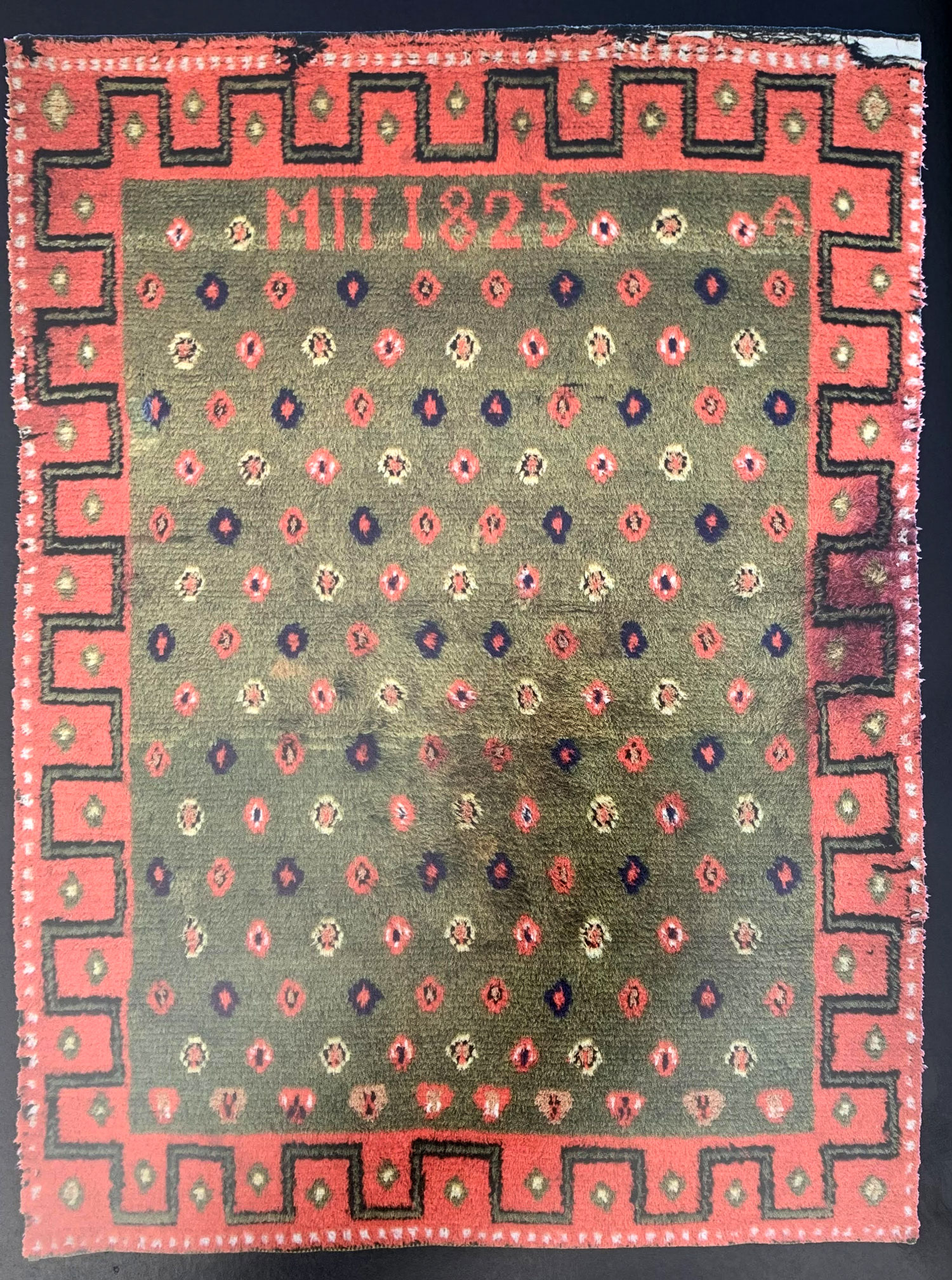
Spot design ryijy 1825      189 x 130 cm (6'2" x 4'3") 
The initials of the owner (MIT) and the year (1825) are in the upper central field.
  The central field is filled with dots.  The bright red and green colours are typical.  


My father came to Canada from Finland at the age of 5 years with his mother, Anna.

This is a post about Finnish rugs.  First I need to say that there are two kinds of rugs made in Finland.  One type is the woven rag rug, usually quite narrow, used as an everyday rug on floors.  I've written about the Finnish rag rug before (here).   My grandmother, Anna, was locally famous for how fast she could weave a rag rug.  My art piece Not To Know But To Go On references the Finnish rag rug, but is not woven, it is stitched.  

The second type of Finnish rug is the rya or ryijy.  Although the rya is considered as art for the wall now, it originally functioned as a warm bed or horse-drawn sleigh covering.   Rya rugs were woven from wool over a linen warp and have a shaggy pile, often on both sides.  This post is about the rya rug.

I'm inspired to write this post because of my recent discovery of  Tuomas Sopanen's collection of rya rugs.   His collection includes pieces from the late 1700's right through to the 21st century.  I am especially interested in the dot grid and the tree of life designs.     

Wedding ryijy 1825  pile on both sides  206 x 148 cm  (6 '8" x 4'8")
This is a wedding rya.  It has the initials of bride and groom ( ABSD and IIS).  


All the images in this post are from Tuomas Sopanen's book,  The Ryijy Rug Lives On. 

Art historian Leena Willberg wrote the text in the book.  
Tuomas Sopanen translated it into English.

Spot design bedcover ryijy 1843  with pile on both sides 174 x 127 cm (5'7" x 4')
Another red and green rya, made for AKSD 


I use grids of dots often as design elements in my textiles and see a connection to these 18th and 19th century pieces.   
 

spot design bed cover ryijy mid 19th century 184 x 154 cm (6' x 5')
When the multi-coloured dots are very dense, the pattern is called 'net'. 


Spot design ryijy 1860 183 x 129 cm  (6' x 4'2")
The dots are simple and sparse.  This rya is a bedcover for one person.

I feel that I made something very similar to a rya rug in 2012 with my green and red wool quilt, Canadian Pioneer.  

What is interesting is that I did not see the connection when I made it.  I knew about rya rugs and had researched them but did not come across images of the older ones.  I am floored by the pieces in Mr Sopanen's collection. The aesthetic of the antique rya is similar to mine - or should I say, my aesthetic is similar to that of my Finnish heritage.

I wrote about Canadian Pioneer on this blog here and here.   

Wedding ryijy 1799 171 x 130 cm  (5'6" x 4'3")
An ancient net design, can you find the date 1799 among the figures?
Diamonds / bridal figures / flowering branches / tree of life symbols in eccentric sizes.  
It was woven in two parts and then joined.

Wedding ryijy 1817   184 x 135 cm
The motifs in this rya are symbols of luck and protection:  hearts, hourglasses, crosses, human figures.
It is rare to have a cow in a Finnish rya rug.  
The initials of the bridegroom are in the central heart (INS) along with the year 1817. 
The pink and green colouring is a variation of the typical red and green.   


Look at the wool art piece that I made from two old blankets in 2021.  It too has dots in an orderly grid.  It has a textural pile on the reverse side.  I made it without consciously thinking about the rya rug.  

I am excited to find the heritage wool bed rugs that have been collected by Tuomas Sopanen.   You can order his book directly from this website if you are interested.  An exhibition of Tuomas Sopanen's collection of rya rugs is at the Saari Jarvi museum until May 22, 2022.  

Saarijarvi is my father's home village in Finland.