Showing posts with label feminism. Show all posts

Sunday, December 14, 2014

At 60, can I stand perfectly still for an hour?

rhythm of a true space (revisited)  1994  and 2014  by Suzy Lake  inkjet print on vinyl on wood, figures larger than life size 

What kind of art do I respond to?

Simple
emotional
Extended Breathing in the Rivera Frescoes  2013-2014  by Suzy Lake  ink jet print
rooted in labour
grounded in nature
Extended Breathiing at the World Trade Center  2012 - 2014  by Suzy Lake   chromographic print
based on repetition
expessing concern for our world
Are You Talking to Me? 1979  gelatin silver prints with applied colour by Suzy Lake  "I was very deliberately thinking about music.  I was trying to create a very frenetic rhythm so that the audience would understand the anxiety"
The photos in this post are from the Suzy Lake retrospective now on at the Art gallery of Ontario.  Suzy Lake began making her autobiographical/conceptual photographs in the early 70's, her work is an important part of the feminist revolution in the art world.

Perhaps her most famous pieces were made when she was an attractive young woman (such as the large gallery installation of self portraits shown above and detail here) but what I was drawn to the most were were the pieces about a woman artist ageing.

The extended breathing series came from her asking herself   "At 60, can I stand perfectly still for an hour?"  Time lapse photographs over a period of 60 minutes show the ghosting of the world around her while she stands still and strong.

"A celebration of breath and life"  Suzy Lake

Wednesday, May 09, 2012

NYC journal: The Dinner Party

I thought that I knew Judy Chicago's Dinner Party. I've seen it in reproduction so much. Most art history texts now include a small photo and a sentence or two about this major collaborative work. I also own a book that is just about it and it's creation. However, viewing the installation in the Elizabeth A Sackler Center at the Brooklyn Museum was very powerful. I didn't expect to be so moved.
The hand made care and determination that went into each place setting touched me deeply. The quiet, dark and reverent room allowed so many feminine spirits a space to communicate with each other and with me.
It was just fantastic.

Wednesday, September 14, 2011

I Love Canada

I Love Canada -- J'Aime Canada 1970, quilted cloth assemblage by Joyce Wieland, collection of Mackenzie Art Gallery, Regina

The newest Canadian Art magazine has an article by Sara Angel about True Patriot Love, the landmark show that opened in 1971 at the National Gallery of Canada. Reason Over Passion 1968, Joyce Wieland, quilted Cloth assemblage, collection of the National Gallery of Canada

Joyce Wieland threw a cocktail party for Pierre Trudeau in 1968, just before he ran for the Liberal Party leadership. She gave him the above quilt with his motto, "reason over passion" made from stuffed fabric. So feminine, so feminist.
So missionary position. The Water Quilt 1970-71 Embroidered cloth and printed cloth assemblage by Joyce Wieland, collection of the Art Gallery of Ontario

One of the pieces in that exhibition was The Water Quilt, made from 64 cushions, each with an embroidered arctic flower. detail of The Water Quilt

When the embroidery was lifted, one could read the text from The Energy Poker Game by James Laxer, a book that outlined the danger of selling Canada's water and other natural resources. installation of True Patriot Love in 1971, National Gallery of Ontario. That gallery's first solo exhibition of a living female artist.

She organized a 100 piece marching band for the opening that played "the maple leaf forever: in the lobby of the gallery. Joyce Wieland in 1964. Filmmaker, quilt maker, painter, ecologist, passionate lover of Canada. She died too young at age 66. (1932-1998).

I've written more about Joyce Wieland, an art heroine for us all, in the modernist aesthetic blog. Click here.

Tuesday, September 16, 2008

Our collective vulnerability

Fragile as a Leaf in Autumn - 2004

The feminist movement of the early 70’s had a huge impact on women’s equality, especially in Europe and North America. Our daughters have been born into this world and it’s become very complex. There is a difference between the feminist art of today and that of earlier periods. The binaries of oppressor / victim and active / passive are not the point of feminist art today. Ambiguity, androgyny, and self-consciousness are.

Multiculturalism, the Internet and globalisation are just three of the factors that have made the contemporary world more connected than it has ever been before. The threat of pandemics, global warming with environmental disasters, terrorism and continuing wars are all contributing to our collective vulnerability.

Tuesday, April 22, 2008

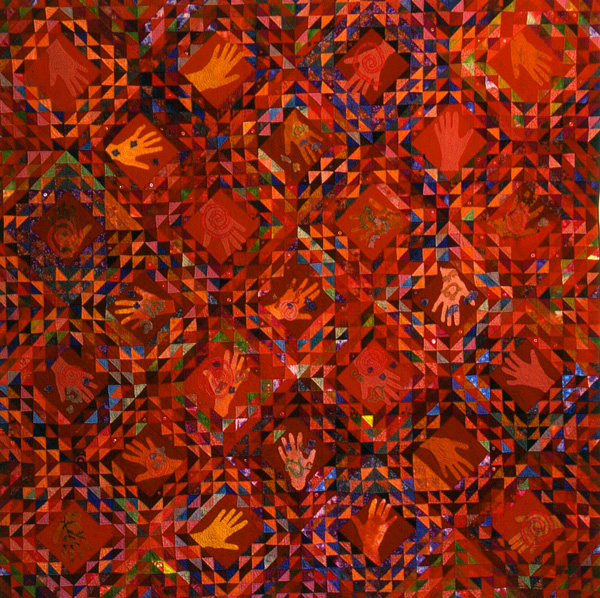
My hand sings red

The spirit of our age.
We are challenged by a new awareness. The concept of difference is a prime concern. Not just the difference between men and women, but the differences among women themselves.

Friday, February 08, 2008

Ghada Amer et moi

Ghada Amer was born in Egypt in 1963 and grew up in France. She will be having a solo exhibition at the Brooklyn Museum this year, opening February 18. Her work references the colour, size and drips of abstract expressionist painting. In fact her work resembles abstract expressionist paintings when it is seen from a distance, but once you get close, everything is very delicate and feminine and neatly stitched. A web of threads slowly reveals a veiled erotic image. The loose threads dangle like paint drips.
Q. How is she able to introduce embroidery into that sacrosanct realm of high art?
A. She breaks rules on both fronts. By introducing thread into her paintings, she blatantly puts forward what has always been regarded as a particularly feminine craft tradition into the fine art world. At the same time she imports an untraditional sensual piquancy into the traditionally pristine realm of women’s stitchery.

Friday, October 12, 2007

Fragile as a Leaf in Autumn

The feminist movement was important in the development of the art quilt.

"This movement, which formed with the diverse goals of securing equal political and economic rights for women, also fostered a deep abiding interest in traditional female craft." Penny McMorris

Women artists have increased in stature since the 70's and there are more of us. Many women artists have discovered quilt making. It is not surprising that a group of serious quilt artists has emerged in the last quarter of the 20th century. However, quilts are still not accepted as fine art in the male dominated art world.

Saturday, February 24, 2007

night sea journey

Male and female: Biological words

Masculine and feminine: Cultural words:

Gender: femininity or masculinity

Essentialism: the belief that our characteristics are related to our biology.

Sexuality: desire or behaviour towards the opposite or same sex.

Gender studies: How are ideas of femininity and masculinity constructed in our culture?

Thursday, February 22, 2007

Post feminism

The kind of artwork I do is nothing like what is written about in art magazines. I'm kidding myself when I think my labour intensive quilted cloth pieces will ever be taken seriously as real art. Today I read reviews of a Rosemarie Trockel exhibition in a recent ART FORUM magazine. She is of my generation and has created a body of work that is rooted in both domesticity and contemporary art theory. (like mine) Rosemarie Trockel's retrospective was entitled "(post) Menopause" and featured two new knitted paintings along with 30 years worth of very conceptual work. At any rate, I become saddened when I realize that quilts that are grounded in tradition (my art form) just don't cut it as "art" in the art world. I guess that if art world recognition is what I really want I will have to push my quilts over the edge. (like Rosemarie has with knitting). Why do I feel that this would be a betrayal to an art medium so rich in metaphor?

Friday, January 05, 2007

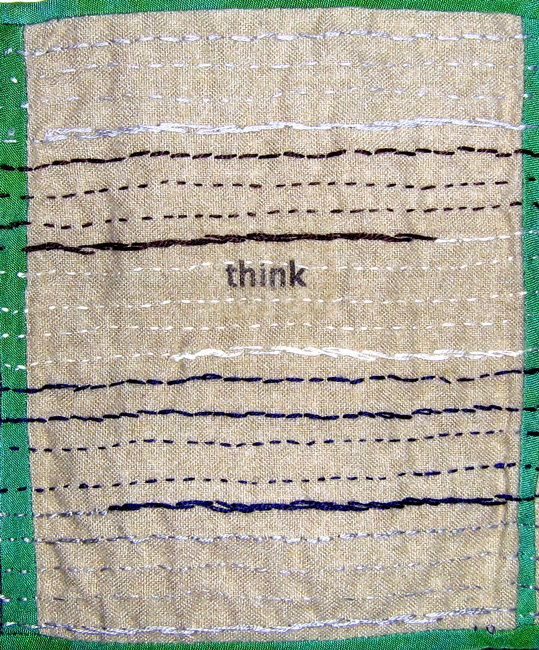
Think

Women artists are not outside of history or culture.
Women artists just occupy and speak from a different position.
This position is essential to the meaning of western culture.

Thursday, January 04, 2007

Griselda and Rozsika

Patchwork quilts are a distinctive form of art with different kinds of relations between maker and object and between object and viewer. These are RICHER than the relations of making, using, and viewing so called "high" art. Work and art come together.

This is what is being effaced by art history when it categorises quiltmaking as decorative, dextrous, geometric and the expression of the feminine spirit.

There is a value system. Any association with the tradition and practice of needlework and domestic art can be dangerous for an artist, especially when that artist is a woman.

Why is the spectre of domestic art so menacing, especially for a woman?
Because high art and the fine artists have come to mean the direct antithesis of all that is defined by the feminine stereotype.

We never speak of masculine art. We never say man artist.
We just say art. We just say artist.

But the art of men can only maintain its dominance and privilege in the pages of art history by having a negative to its positive. Ideology is not conscious. It works unconsciously. It reproduces value and belief systems of the dominant group. Male dominance began in the Renaissance and expanded in the 18th century. It was articulated in the 19th century and by the 20th century was so NATURAL that it was taken for granted and women artists were just not mentioned any longer in the art history books.

If feminine is the negative of masculine, and if masculine is dominant, how do women artists produce meanings of their own if the language we use affirms men’s dominance and power and reproduces their supremacy?

paraphrased from Old Mistresses: Women, Art and Ideology by Rozsika Parker and Griselda Pollock (1981)