Showing posts with label vintage fabrics. Show all posts

Thursday, September 22, 2016

junko oki

More than often, studying something too much may lead to confusion - Junko Oki
 I used red thread to create stitches that capture my soul - Junko Oki
When I said to someone that I wanted to show both sides of my work, I was told that to do so was unprofessional.  I should only show my best side, the side which is more beautiful and commit to it. Sensible advice, buut I still want to show the back side.  Why?  I don't know.  Maybe finding a reason to that question is an important topic for me to pursue.  Junko Oki
When I touch an old fabric I feel like I'm going back in time.  Junko Oki
Memories can be implanted into material - Junko Oki
I want to make many small pieces.  I love to work spontaneously and follow the path my intuition leads me.  Junko Oki

All images and text in the above post are from Junko Oki's new book, Punk.

Art by contemporary artists like Junko Oki  combine with traditional folk textiles from around the globe as inspiration for the one day workshops I'm teaching in London this week.
The circle:  A universal symbol of wholeness and unity, timelessness, no beginning, no end, no above, no below.  Spacelessness.  Dynamic and endlessly moving, a complete cycle, natural perfection.  J. C. Cooper

Tuesday, June 09, 2015

women's work, women's worth

I am re-blogging  someone else's post
about women's self esteem
and speaking out loud about our own worth
and our own work.
Arlee Barr shared it on facebook, which is how I found it.
Here it is:        The Pale Rook - June 5
However, all the images in this post are of the vintage crazy patchwork art-piece that Julia McCutcheon brought in to share with the slow stitch group last week.  She'd brought it in before, but I didn't have my camera with me and I asked her to bring it again so that I could photograph it.
 I thought that you might enjoy the zig zags and the birds,
the red thread,
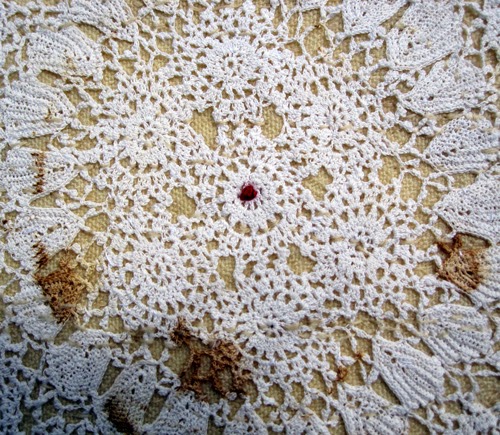
 and the re-purposed hems from vintage linens.
The outlining of those perfect bits, discovered and saved.

Sunday, May 17, 2015

the light the hope

Lake - indigo dyed and hand stitched quilt on left.
The Light of the Moon - acrylic, thread, paper and cotton wall piece on right.
Before I delivered my work to Shannon at the Perivale Gallery earlier this month, I re-read the journal text in the stitched paper collage.
The darkness will always be there but you can see the light of the moon as hope.
 
I am showing three pieces at the Perivale Gallery this year.
Left to right:  Duet, Lake and Light of the Moon.
Ivan Wheale will be in attendance at the opening on May 17.  I hope that it will be well attended.

Tuesday, February 10, 2015

Normal School Sewing Book

 
Today, a post about the Hamilton Normal School Sewing Book, loaned to me years ago by my friend Nicole Weppler, curator of the Gore Bay Museum here on Manitoulin Island.  Above, the sample for beautifully executed patchwork mending.

Patching:   a patch is a piece of material inserted for the purpose of strengthening worn or thin places 
The student's name was Helen J Scott, she was in the grade A class, room 4.  It was 1910. 
Normal school is not where you go to become normal.  Normal School is a term for what we now call teacher's college.  My mother went to Normal School in the 40's.
Sewing is the process of drawing thread through material by means of the needle. 
Cloth is the material made of animal and vegetable fibres
RUNNING
straight stitch
1.       stitches and spaces are of equal length
2.      Looks the same on both sides
3.      Stitches and spaces follow each other straight along the sewing line
4.      The stitch is as small as the cloth will permit 
OVER CASTING
slanting stitch
1.       Looks the same on both sides
2.      Stitches and spaces are of equal length
3.      Stitches and spaces are at right angles
4.      Stitches are always parallel and so are the spaces
Use – to prevent raw edges from ravelling
HEMMING
slanting stitch
Description 
       1.  looks the same on both sides. 
       2.   Stitches and spaces  form right angles.
       3.  Looks like overcasting, but the thread is carried through the body of the cloth and over the edge.
Use  to fasten an edge smoothly to the body of the cloth.  A) hems  b) facings 
 FRENCH SEAM
 FELLED SEAM
PLAIN BUTTON HOLE

Definition- a button hole is  a slit in the material with the edges protected and strengthened by thread and used to slip over a button to hold two pieces of cloth together

Marking – mark where the shank of the button should come.  If cutting with ordinary scissors, mark a point at both ends of the button hole

Cutting – when cutting stick point of scissors in at the shank end of the buttonhole and cut a straight slit the required length.
Do not double the cloth but cut through all the layers at once
Whenever possible, the cut should be straight with the warp or woof

Making – 
1. Make the stitches deep enough to prevent fraying but not to look clumsy
2. Stitches not crowded but close together – just showing the cloth between
3. Begin almost any place with two or three stitches in the same place about the width of the stitch from the edge, hold the thread down firmly with the thumb, throw the thread over the needle to make a loop then draw this firmly and smoothly in place.  
4. Repeat. 
EYELETS
HOOKS AND EYES
SEWING ON BUTTONS
DARNING

Definition:  Darning is the process of inserting new threads in material in order to repair worn or broken threads
 BAG
size of bag  width 5" depth 5"
 The book is hand bound with a shoe lace.
I appreciate this book.

Tuesday, April 29, 2014

time, dream, memory

In this post, new work with old materials
time, dream, memory: time, 8 x 10" van dyke print, hand made paper, vintage wool, vintage photo frame, hand stitch, 2014

time, dream, memory: dream, 9 x 11", van dyke print, hand made paper, vintage wool, vintage photo frame, hand stitch 2014

time, dream, memory: mother  9 x 14"  van dyke print, hand made paper, vintage wool, photo frame and lace doilies,  hand stitch   2014

time, dream, memory: memory   8 x 10" van  dyke print, hand made paper, vintage wool, vintage photo frame, hand stitch 2014 
 
  time is material

Thursday, January 03, 2013

monumental repetition

the repetitive  eyelet
row after curved row of circles
of eyelet repeats
buttonhole loops around and around
pulling gently at the center to make holes
contained voids
the fabric stronger with the addition of thread
rows of strong holes
small marks
small windows
small voids
all round and neat and tight and packed as if they are the fabric
it's so labour intensive and slow, you can't imagine
while my family is visiting I stay up late
I stitch until 2 or 3 am every morning like I used to do when the kids were young and at home
actually I look forward to it
I hardly slept when I was a mother-artist
now I am a grandmother artist
how long does it take ?  an hour? 3 hours?
double that
triple it
the amount of time and repetitive movement in this piece of cloth is monumental
it's obsessive, the repeating I do of the same gesture
it's like tying skates, tugging gently with each eyelet
like dancing, turning the fabric in my hands to make the circles
the result is so delicate
like snow flakes
like flowers
like fields and rows of planted, weeded, tulips
fileds of holes
fields of buttonholes and unimaginable time spent
stitching soothes me after a day of trying too hard
what will please everyone?
what would they like to eat?
should we go for a walk?
should I read? talk? listen?
stitching these solid strong lines of white
up and down, over and through, do it again
over and over and over
the same rhythm, the stronger fabric
it's heavier, weightier now
and there is still much to do

Friday, September 07, 2012

eyelet stitch

 
Finally, we begin the last section of the last panel.  These eyelet stitches are for the upper half of the inner circle.  

 
An eyelet stitch is essentially buttonhole stitch worked in a circle around a single entry place.  The stitches form a central hole in the fabric. 
 It's slow work, but that's OK.  We don't want to finish things quite yet.
We enjoy the weekly stitching .  Next week we'll probably "roll"  the third panel, Precious Water, twice.  From both sides.
Also next week we are celebrating three years of working together with an Open House.  I will be tracing the hands of all those who have contributed to the project, and we will have cake.


All welcome, 10 am till 6 pm, every Thursday.  See more information on the sidebar.

If you have stitched on these quilts and can't make it to the Little Current United church hall on the 13th September, please mail me a tracing of one of your hands and its wrist.  Email me for the mailing address.